

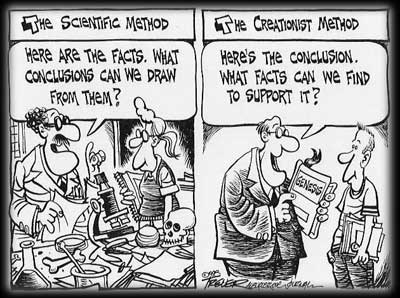
Showing posts with label intelligent design. Show all posts

Intelligent Design to Natural Selection there are a spectrum of views

Intelligent Design to Natural Selection: Spectrum of Views

There are a spectrum of views, or cases, from Intelligent Design (of a “progressive creationist” sort) at one end — to Natural Selection at the other:

CASE 1) The Designer fiddles with genes of various creatures every once a while to produce an evolutionary-like progression of forms throughout geologic time.

Though there appear no necessary reasons why such fiddling must involve short steps rather than long ones, nor why it necessarily had to follow an evolutionary-like pattern of descent with modification over time as it certainly appears to. And questions remain whether individual creatures were fiddled with, or entire populations simultaneously; and also whether the Designer ensures that the creatures with the new genes survive and reproduce (more than those without the new genes), because if the reverse were true, even giving the creatures new genes would not ensure that those genes were passed along.

So the Designer in…

  • Case 1) apparently has to keep introducing new genetic changes in small increments over vast eons of time, restricts himself to always building on what came before, and also has to watch over individual creatures (and/or a population of them) to make sure they reproduce and pass along those new genetic changes he has made in their DNA.

  • Case 2) The Designer does not fiddle with the genes as in CASE 1) but allows them to mutate naturally over vast eons of time. But the Designer does ensure that specific mutations get passed along by making sure which creatures survive and reproduce, and/or which creatures die. In this case no direct fiddling with genes is necessary, just a fiddling with which creatures survive and breed to pass along particular mutations that the Designer deems appropriate to pass on, and perhaps the Designer also stops some creatures from breeding, the ones with the old mutations.

  • Case 3) The Designer sets up nature “in the beginning” such that mutations continue to occur naturally, and creatures produce lots of offspring, but only a fraction of them survive and breed and thus pass along their genes to the rest of the population. In this case their survival depends on natural circumstances, not a supernatural picking and choosing of which creatures survive and which do not.

The third option above is modern day “neo-Darwinism,” which need not exclude a Designer, just a Designer that allows nature to do her own job — via a cosmos created “in the beginning.” (When I consider the three options above, I must admit, creating something that can itself create other things, is the most impressive of the three options, at least to my mind. I mean, pulling a rabbit out of a hat every now and then may be impressive, but having to keep pulling tiny rabbits out of hats for a billion years seems too “labor intensive” — and doesnʼt seem as impressive to me as creating the element known as carbon with the inherent properties such that it can evolve in billions of years into a human being all on its own.)

Notice that option 1) involves a Designer “fiddling” by introducing specific point mutations in a gene, or instantaneously adding new genes or new chromosomes, such that even if a scientist was there watching it happen (watching those genetic changes underneath a microscope of a cell that was still living and attached to the organism in question) such first-hand observation could tell that scientist nothing about the nature, or causal reason, or the “science” behind what had just happened, except that it was an apparent miracle.

It would also be a miracle in the case of option 2)in which the Designer miraculously fiddles with the destiny of particular organisms, miraculously choosing which survive and reproduce and which die (in order to ensure that specific mutations “out-compete” other mutations in nature).

Another point I would make is that there is nothing particularly “scientific” about watching something pop miraculously into existence, or watching one creature rather than another survive in a totally miraculous fashion (so it could reproduce and leave more offspring).

To use the “rabbit out of the hat” illustration again, if I knew a magician who performed genuine magic (instead of carefully orchestrated “tricks”), and I watched him pull a rabbit totally miraculously out of the air inside his hat, that would teach me nothing, certainly nothing scientific about either hats or rabbits or about any genuine connection between the two. It would only prove to me that I had witnessed a “performance.” But as a scientist qua scientist, I would still want to know how the trick was done. By what “means” was a rabbit produced from the inside of that hat? Even if the means were miraculous, a scientist would want to find out what the exact ways and means of performing that particular miracle were. In the case of a Designer designing creatures over geologic time a scientist qua scientist would be dying to find out more about how it was done and why in that particular way and what thoughts were going through Godʼs mind at each moment. In other words, a scientist qua scientist would not be satisfied that “it just happened,” but remain curious about how it happened, what steps there were leading up and through the process, what connected with what, and why they connected.

And since we cannot know such things in cases 1) or 2) above, since the ways and means are deemed absolute miracles, I think it quite appropriate of “scientists qua scientists” to continue to investigate the matter from the practical perspective of 3).

Even as a creationist I used to wonder why God ever bothered to create creatures like chimps and apes, that were more similar to human beings than any other creatures in both looks and behaviors, mockingly so, intriguingly so. And then when I later discovered that there were other primates in the geological past, that even creationists could no longer explain their remains away as “random bones,” such as Homo Erectus (not a hoax from China, but found in Africa too!), I began to question my creationist beliefs.

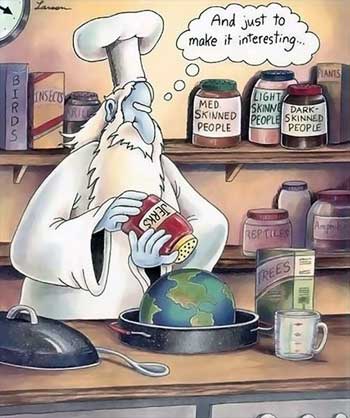
The Fine-Tuning Argument — Ideal Moment in Time for Humans To Have Been Created?

The Fine-Tuning Argument

Some theists (from progressive creationists to I.D.ists and Fine-Tuners) have argued that humanity was created at the ideal moment in geological time, viz.: A God of infinite wisdom and power prepared the way for the ascendancy of mammals and eventually Homo sapiens by carefully planning and accomplishing the dinosaurʼs demise via asteroid, or a combination of major volcanic activity and asteroid. The vast forests grew and decayed for over a hundred million years because of Godʼs plan to provide coal to humanity and so such products would not appear artificially inserted miraculously into Nature. The millions of sea creatures were born and perished to provide oil, natural gas, chalk, and diatomaceous earth for humanity. (For one of the earliest instances of such an argument see Bernard Ramm, The Christian View of Science and Scripture, [1955] Paternoster: Exeter, Devon UK, 1967, reprint, p.155.)

Reply: Arguments and claims about what “God” or “a Designer” did, and “why” they did it, are all “after the fact.” Itʼs always possible to come up with rationalizations and justifications for “why” something happened after the fact, since you are free to invent whatever interpretations you like since the answers lay hidden from view, i.e., in Godʼs mind alone. (Interpreting Scripture is also like that. Two people can read Genesis, but interpret it quite differently, and neither of them can show the other what “Godʼs mind” was thinking when He inspired a particular verse in Scripture, thus contested interpretations abound.) One can at best, point out alternative, equally ad hoc, interpretations, i.e., substituting different “reasons” or “rationalizations” for what you think might have been in Godʼs mind. Going into greater detail, below are

10 Counter-Points to the Fine-Tuning Argument

  1. What if God or “the Designer” was planning on evolving upright dinosaurs with two free hands and more complex brains, but the asteroid spoiled the original plan, so the Designer switched plans? (Any Designer with infinite wisdom and infinite power could have designed an intelligent upright reptilian species. According to paleontologists, some species of dinosaurs were already moving along on two legs long before mammals arose, while other evidence indicates that some dinosaurs were clever hunters and even showed motherly defense of their young, long before the mammals came along.)

  2. Why kill the dinosaurs via asteroid(s) and/or volcanoes? Such blunt means wipe out entire ecosystems of plants and animals that could have produced far more biomass and more coal and oil if they had been left alive. That was supposed to be the original argument, wasnʼt it, to produce coal and oil? Instead, whole ecosystems and their biomass was burnt up via a huge catastrophic conflagration followed by a cloudy sky and cooler temperatures that again inhibited lush biomass grow. (Any Designer of infinite wisdom and power could have exterminated only the dinosaur species, leaving the rest of the living world unharmed and building up more biomass. Looks to me like a lack of foresight and imagination on the part of the Designer, kind of like using a sledge hammer to remove thorns from a rose bush. Instead, a lot of biomass went to waste, not just the dinosaurs, but ecosystems, and so the biomass engine was stalled.

  3. That brings us to this question: Why are miracles O.K. for explaining the “progressive creation/evolution” of different species, but not O.K. for explaining the creation of the mineralogical environment that God was preparing for humanity for so very very long? I am talking about the idea that God could have simply inserted miraculously all the oil and coal in the earth that humanity would need, without having to create humanity so late in geologic time, and without having to wait for so many species to be created and then be destroyed and become extinct, and without having to stall the biomass engine a number of times, etc.

    A relevant quotation: Suppose that upon some island we should find a man a million years of age, and suppose we found him living in an elegant mansion, and he should inform us that he lived in that house for five hundred thousand years before he thought of putting on a roof, and that he but recently invented windows and doors; would we say that from the beginning he had been an infinitely accomplished and scientific architect? [Robert Ingersoll]

  4. How do you know that the Designer “wanted humanity to have” oil, coal, gas, chalk, diatomaceous earth, etc.? And what does having such things have to do with salvation? It doesn't. Moreover, claiming that “God wanted such and such” after the fact proves nothing. You can always invent lots of explanations after the fact, like:

    God put the nose and ears where they are so weʼd be able to wear glasses.
    God made cork trees so weʼd have something to plug up the ends of our wine bottles.
    God invented lambʼs intestines so weʼd be able to make lamb-skin condoms.
    God made radioactive elements so weʼd be able to…
    You get the point.

    Quotations From Folks With Similar Questions:

    People who believe in “intelligent design” point us to the sunshine, to flowers, to the April rain, and to all there is of beauty and of use in the world. Did it ever occur to them that a cancer is as beautiful in its development as is the reddest rose? That what they are pleased to call the adaptation of means to ends, is as apparent in the cancer as in the April rain? By what ingenious methods the blood is poisoned so that the cancer shall have food! By what wonderful contrivances the entire system of man is made to pay tribute to this divine and charming cancer! What beautiful colors it presents! Seen through a microscope it is a miracle of order and beauty. All the ingenuity of man cannot stop its growth. Think of the amount of thought it must have required to invent a way by which the life of one man might be given to produce one cancer. Is it possible to look upon it and doubt that there is a design in the universe, and that the inventor of this wonderful cancer must be infinitely powerful, ingenious and good? [Robert Ingersoll]

    We are all naturally like that madman at Athens, who fancied that all the ships were his that came into the Port of Pyraeus. Nor is our folly less extravagant. We believe all things in nature have been designed for our use. Ask any theologian why there is such a prodigious number of stars when a far lesser number would perform the service they do us, and he answers coldly, “They were made to please our sight.” [Bernard de Fontenelle, A Plurality of Worlds, published in 1686]

    If Other Species Had Enough Intelligence to Ask the Question Wouldnʼt They Consider the Cosmos To Have Been Made “For Them?”

    Until the 1800s almost everyone had fleas and lice. In the 1600s it was considered bad manners to take lice, fleas or other vermin from your body and crack them between your fingernails in company. [Tim Woods and Ian Dicks, What They Donʼt Teach You About History] Obviously only a Designer would have had the infinite wisdom and compassion to create “the flea” - a tiny insect with a thin body for moving easily through hair, and with immensely powerful legs for leaping many times their body length onto passing prey; and with the added ability to not just harry and bite, but to spread infections, including plague germs which killed tens of millions of people in Europe and Asia in a few short years. My dear fleas, you are the cherished work of God; and this entire universe has been made for you. God created man only to serve as your food, the sun only to light your way, the stars only to please your sight, etc. [Voltaire, “Sermon Preached Before Fleas”]

    An Infinite Being Takes Billions of Years to Create Humanity?

    Are we really so splendid as to justify such a long prologue? The philosophers lay stress on values: they say that we think certain things good, and that since these things are good, we must be very good to think them so. But this is a circular argument. A being with other values might think ours so atrocious as to be proof that we were inspired by Satan. Is there not something a trifle absurd in the spectacle of human beings holding a mirror before themselves, and thinking what they behold so excellent as to prove that a Cosmic Purpose must have been aiming at it all along? Why, in any case, this glorification of Man? How about lions and tigers? They destroy fewer animal or human lives than we do, and they are much more beautiful than we are. How about ants? They manage the Corporate State much better than any Fascist. Would not a world of nightingales and larks and deer be better than our human world of cruelty and injustice and war? The believers in Cosmic Purpose make much of our supposed intelligence but their writings make one doubt it. If I were granted omnipotence, and millions of years to experiment in, I should not think Man much to boast of as the final result of all my efforts. [Bertrand Russell, “Cosmic Purpose” in Religion and Science]

    The Analogy of the Puddle That Perfectly Fits The Hole It Happens to Occupy

    Imagine a puddle waking up one morning and thinking, “This is an interesting world I find myself in and an interesting hole I find myself in. Fits me rather neatly, doesnʼt it? In fact it fits me staggeringly well, must have been made to have me in it!” This is such a powerful idea that as the sun rises in the sky and the air heats up and as, gradually, the puddle gets smaller and smaller, itʼs still frantically hanging on to the notion that everythingʼs going to be alright, because this world was meant to have him in it, was built to have him in it; so the moment he disappears catches him rather by surprise. I think this may be something we need to be on the watch out for. [Douglas Adams (author of the Hitchhikerʼs Guide to the Galaxy)]

  5. Knowing the remarkable varieties of species the Designer was busy creating for hundreds of millions of years prior to humanityʼs last minute arrival on the scene, it seems a shame to destroy the majority of them, sometimes slowly, sometimes in vast catastrophes. Like knocking over a game table. What kind of a “game plan” is that? While humanity only gets to puzzle over their bones?

  6. Nor do we know how long manʼs “ascendancy” or those of the mammals will last. If we get along for 130 million years like the dinosaurs did weʼll be lucky, and if we survive for a similar period of 130 million years, what will human beings look like by then? Maybe weʼll have added genetic features via bioengineering? Or weʼll build silicon brains or hybrid silicone/bio brains that keep track of far more knowledge. Or, some robotic, or bio-engineered species will replace humanity? Or some meteors or cosmic rays or solar flares or passing star or black hole or nearby nova will extinguish life on earth and some other civilized race traveling through our solar system will merely cite “the story of life on earth” as an object lesson concerning the dangers inherent in the cosmos.

  7. What about life on other planets? If evidence of simple living organisms are found on Mars, or on one of Jupiterʼs moons, or on some planet or moon outside our particular solar system, how would the creation hypothesis or the I.D. hypothesis interpret such discoveries? Would the creationist admit God was specially creating things not mentioned in the Bible, or the I.D.ist admit that God was miraculously designing simple organisms elsewhere in the cosmos that didnʼt really need to be miraculously designed?

  8. Reminds me of the account in Genesis that states God created the two great “lights” (literal Hebrew is “lamps”) to rule the day and night on earth, but other planets in our solar system also have great lamps, even a multitude of lamps (moons) to rule their nights and “for signs and seasons” in their heavens. I might ask why this is so, and why those planets also have their own “days and nights” “evenings and mornings” of their own unique duration having nothing to do with the earthʼs duration? Modern astronomical facts make the Genesis account appear a tad parochial, earth-centered, having everything created just to light the earth and fill it, during “six” evenings and morning on earth. And a little awkward having to explain why God created/designed all those other “lamps” to “rule the nights” of uninhabited worlds.

  9. Even if a Designer planned to give us coal and oil, note that the burning of coal has released much mercury into the environment all over the planet. Now the mercury levels are so high that it is not advisable to eat large ocean going fish more than a few times per month or less, like tuna. The burning of coal and oil and using petroleum to manufacture plastics and to run factories has released pollutants galore, including PCPs, which also are polluting the entire planet. In fact the Killer Whales in the Pacific Northwest are dying out because of PCP poisoning according to a National Geographic special I saw recently, “The Dolphin Defenders.” The carcasses of dead Killer Whales are so full of PCPs that they have to be treated like dangerous chemical waste. And of course, we also know that the worldʼs oil supply will not last forever, because demand, especially in China and India is growing exponentially. In a blink of geological time, mankindʼs industrial revolution may have come and gone:

    “It has often been said that, if the human species fails to make a go of it here on Earth, some other species will take over the running. In the sense of developing high intelligence this is not correct. We have, or soon will have, exhausted the necessary physical prerequisites so far as this planet is concerned. With coal gone, oil gone, high-grade metallic ores gone, no species however competent can make the long climb from primitive conditions to high-level technology. This is a one-shot affair. If we fail, this planetary system fails so far as intelligence is concerned. The same will be true of other planetary systems. On each of them there will be one chance, and one chance only.” (Hoyle, 1964)

  10. See, the second and the fourth articles at this site:

    Why We Believe In A Designer!

    They explain why the concept of “providence” seems to raise as many questions for some as it answers for others.