Showing posts with label creation science. Show all posts

Challenge to Dr. Kent Hovind to provide empirical evidence for Creationism

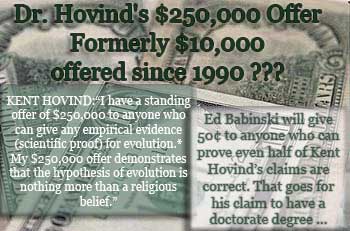
Kent Hovind's $250,000 challenge

Ed Babinski:

“Ed Babinski will give 50 cents to anyone who can prove that even half of Kent Hovindʼs claims are correct, and that goes for his claim to have a ‘Doctorate’ degree based on a level of course completion and study that is even half as rigorous as the doctorate degrees acquired at genuine institutions of higher learning.”

Harry: Like all Creationists they also believe in “The Golden Rule” … he who has the gold makes the rule. Even if he offered all the money and land he had, no one will ever get one single cent of it because of his “Golden Rule”. If he has lived 74 years believing this out-dated religious crap while denying facts, then anyone is simply foolish to waste time hoping to claim his illusive prize.

From: Sharon
To: “Ed Babinski”
Sent: Sunday, July 24, 2005
Subject: Has Kent Hovind Renigged on his 250K Offer?

I could not locate the challenge on his site.
What is the URL now if the offer still exists?

When I checked the link this came up:

Not Found
The requested URL /Ministry/250k/index.jsp was not found on this server.

Apache/2.0.53 (Unix) mod_ssl/2.0.53 OpenSSL/0.9.7d PHP/5.0.3 Server at www.drdino.com Port 80

On 7/29/2005 2:58:09 AM, John Stear wrote:
Subject: Hovindʼs 250K Offer, Gone?

[…]

No Answers in Genesis — Kent Hovindʼs Phony Challenge

Itʼs from my Hovind page you quoted.

Cheers

John

Man masters nature not by force but by understanding. This is why science has succeeded where magic failed: because it has looked for no spell to cast on nature.
—Jacob Bronowski (1908 - 1974) British historian and mathematician.

Be sure to visit my web site “No Answers in Genesis”

Now, letʼs take a look at what Dave Matson has to say:
How Good Are Those Young-Earth Arguments?
A Close Look at Dr. Hovindʼs List of Young-Earth Arguments and Other Claims

Are you up to Edʼs Challenge?

Anna takes the Fifty Dollar (now reduced to fifty cents) Challenge

“Betting on Geocentrism”

(Kent Hovindʼs ‘Bet’ not Unique)
Edward: Here is an article about Elmendorf, who has a standing offer of $10,000 for a proof that the Earth moves around the Sun, and $5,000 for a proof that the Earth rotates on its axis.

Who said thereʼs nothing new under the sun?
by Brian OʼNeill (post-gazette.com)
Monday, January 21, 2002

As weʼre nearing the end of our conversation at his dining room table, R.G. Elmendorf says to me, “I have the perfect title for your column: ‘Crackpot in Glenshaw’.” The next morning, a letter arrives in my mailbox. Itʼs from Elmendorf, suggesting that “Off-the-Wall in Glenshaw” might be better. As I donʼt write the headlines, I donʼt know what the editor is calling this, but I mention it to make clear that Elmendorf, 74, is well aware of how far out his quest is.

He has spent more than two decades offering a reward to anyone who can prove what almost everyone believes: The Earth revolves around the sun. He recently upped that reward offer from $1,000 to $10,000: five grand to anyone who offers “scientific proof positive” that the Earth orbits the sun; another five grand to anyone who proves that the Earth rotates on its axis. He doesnʼt expect to have to take out a second mortgage to pay anyone soon.

How often do you meet a guy willing to take on Copernicus and Galileo anymore? For generations, schoolchildren have been making Styrofoam solar systems with a big olʼ sun in the middle and the nine planets hanging out on wires. Hereʼs a guy suggesting they might have deserved Fs. Heʼs not sure, mind you. He just believes itʼs an open question — hence, the funky steel model that was on his dining room table when I arrived. It was an armillary sphere, not unlike the ones used back in the pre-Copernican day, with Earth at the center of the solar system and the sun just another orb spinning round. By my unskilled calculations, the Earth has been around the sun nearly 22 times since Elmendorf first offered the reward on March 10, 1980. The Earth has rotated on its axis almost 8,000 times. But I canʼt prove that. Thatʼs the rub.

“The required proof must be direct, observable, physical, natural, repeatable, unambiguous and comprehensive — in other words, conclusive scientific evidence of the celestial state of affairs,” his reward offer states. “Hearsay, popular opinion, ‘expert’ testimony, majority vote, personal conviction, organizational ruling, conventional usage, superficial analogy, appeal to ‘simplicity’ or other indirect means of persuasion do not qualify as scientific proof.” In short, he is harder to convince than the O.J. jury. As his wife of 51 years, Virginia, made coffee, I asked what had led him down this celestial path. Heʼs no astrophysicist. A mechanical engineer who earned his degree from Cornell University in 1950, he has an engineering, design and fabrication shop in West Deer, 10 winding miles north of his home. (Donʼt drive behind him; his license plate warns “STACALM” because he drives as slowly and meticulously as he does everything else.) His unconventional journey began conventionally enough. He became a fundamentalist Christian, accepting the Bible as the literal truth. That led him to question scientific wisdom. When he discovered the “Copernican arrangement” of the solar system hadnʼt really been proven, at least to his engineering standards, he was shocked.

Donʼt tell him about the Foucault Pendulum, the 19th-century device that purportedly shows that our planet rotates beneath a pendulum whose motion remains fixed in space. Elmendorf self-published an 82-page book in 1994 declaring the pendulums fakes.

“Iʼve pretty much concluded the proof isnʼt out there,” he said.
The problem is distinguishing between a moving Earth and a moving universe. Iʼm told not even Isaac Newton solved that problem. The astronauts havenʼt gotten us any closer to the truth either, according to Elmendorf.

If you think you have what NASA and Newton lacked, write to R.G. Elmendorf at 208 S. Magnolia Drive, Glenshaw 15116. Because when the sun sets — excuse me, appears to set — tonight, Elmendorf will still be sitting on his money.
Brian OʼNeillʼs e-mail address is boneill@post-gazette.com.


Giants in Early Australia

Marshall writes: See this website, and Australian finds tools and fossils of giant Australians!
Yowie

Edward: The author of the above article, “And There Were Giants” (published in the Psychic Australian, Oct. 1976) is Rex Gilroy, a believer in pyramids lying far beneath the seas and lots of other unusual stuff to say the least. See Gilroyʼs homepage

Note that the photos in Gilroyʼs article are all of himself and his so-called “discoveries,” namely a few large rocks and some casts of what he claims are genuine “giant human footprints.” Rex vainly tries to “link” his discoveries with those of the famous anthropologist, Dr. Ralph von Koenigswald, who discovered fossilized teeth and jaw remains of the largest known species of ancient ape, Giganopithecus.

Problems

  1. Rex cites only the most exagerrated height figures for Gigantopithecus. Gigantopithecus (of the Middle Pleistocene of what is now northern Vietnam and southern China) featured males that stood an estimated 9 ft tall and weighed about 272 kg 600 lb. Please note that it is risky in the case of large primates to correlate tooth size and jaw depth of primates with their height and body weight, and Gigantopithecus may have had a disproportionately large head, jaws and teeth for his body size. So it could have been smaller than 9 ft. tall. And the only Gigantopithecus remains that have been discovered so far are three partial lower jaws and more than 1,000 teeth.

  2. Rex wants to believe that the fossilized teeth and jaw remains of Gigantopithecus point to it having been human. It was not. See, “The Ape That Was: Asian Fossils Reveal Humanityʼs Giant Cousin” by Russell L. Ciochon for a detailed discussion of why Gigantophithecus was a species of ape.

  3. Rex believes his rocks are “tools,” yet I donʼt see any chisel marks or even usage marks on those mishapen rocks that Rex picked up. (And if young-earth creationists believe in “giants before the Flood” and that Rexʼs “human giant” was one of them, they ought to also consider the old adage “sinks like a stone,” and ask themselves how Rexʼs huge “stone tools” floated on the waves during “The Flood of Noah.”)

  4. Rexʼs so-called genuine “human footprints” are flat, they have no arch, the toes looked splayed in a fake fashion. Just check out these photos of them at Rexʼs page

In short his “human footprints” lack any true anatomical features. And furthermore, he apparently found them lying on the topmost surface of the land, the prints were not dug up beneath any sediments. And he claims they were made recently, and that such creatures are alive now. He calls these creatures “Yowies.” Below is a story of someone who took a trip with Rex in the outback looking for evidence of his beloved “Yowie.”

The yowie, on the other hand, has left only meager traces of its supposed existence, like those of other hairy man-beasts reported around the world. These include the Himalayan yeti, the North American sasquatch, and similar creatures alleged to inhabit remote regions of China, Russia, southeast Asia, and elsewhere.
The yowie is a fearsome, hairy creature of Aboriginal mythology. Also called Doolagahl (“great hairy man”), it is venerated as a sacred being from the time of creation which the Aborigines call the Dreamtime. An alleged sighting by a hunting party of settlers in 1795 was followed by increased reports from the mountainous regions of New South Wales [thatʼs a region of Australia, not Britain] in the nineteenth century. For example, in 1875 a coal miner exploring in the Blue Mountains west of Sydney, Australia reportedly stalked a hairy, apelike animal for a distance before it finally eluded him. Sightings of the yowie mounted as settlers penetrated the countryʼs vast interior, and yowie hunter Rex Gilroy (1995, 197) now notes that his files “bulge with stories from every state.”

The self-described “‘father’ of yowie research,” Gilroy (1995, 202) boasts the acquisition of some 5,000 reports together with a collection of footprint casts, but he complains of “a lifetime of ridicule from both ignorant laymen and scientists alike.” When Peter Rodgers and I ventured into the Blue Mountains, we experienced something of the prevalent local skepticism at the information center at Echo Point (in the township of Katoomba). Staffers there were emphatic that the yowie was a mythical creature pursued by a few fringe enthusiasts. (To them yowies exist only as popular toys and chocolate figures marketed by Cadbury.) Nevertheless, to Gilroy “the Blue Mountains continues to be a hotbed of yowie man-beast activities-a vast region of hundreds of square miles still containing inaccessible forest regions seldom if ever visited by Europeans.” The fabled creatures are known there, he says, as the “Hairy Giants of Katoomba” and also as the “Killer Man-Apes of the Blue Mountains” (Gilroy 1995, 212).

In the Katoomba bushland, Peter and I took the celebrated “steepest incline railway in the world” (built as a coal mine transport in 1878) down into Jamison Valley. The miserable weather gave added emphasis to the term rainforest through which we “bushwalked” (hiked) west along a trail. We passed some abandoned coal mines that Peter humorously dubbed “yowie caves,” before eventually retracing our route. We saw no “Hairy Giants of Katoomba” but, to be fair, we encountered little wildlife. The ringing notes of the bellbird did herald our visit and announce that we were not alone.

Resuming our drive we next stopped at Meadlow Bath, an historic resort area overlooking the Megalong Valley-also reputed yowie country (Gilroy 1995, 217-218). From there we surveyed the countryside which was, however, largely shrouded in fog. We continued on to Hartley, then took a narrow, winding road some 44 kilometers to Jenolan Caves. Gilroy (1995, 219) states that the Aborigines believed the caves were anciently used as yowie lairs, and he cites reported sightings and discoveries of footprints in the region.

We passed through the Grand Arch, a majestic limestone-cavern entranceway into a hidden valley, and surveyed the spectacular grotto called Devilʼs Coachhouse, continuing our cryptozoological pursuit. We searched the surrounding mountainous terrain (see figure 3) for signs of the elusive yowie, again without success. Here and there the raucous laughter of the kookaburra seemed to mock our attempt. An employee told us he had worked at the site for three years without seeing either a yowie or the innʼs resident “ghost,” indicating he believed in neither.

Failing to encounter our quarry, we ended our hunt relatively unscathed-soaked, to be sure, and I with a slightly wrenched knee. But consider what might have been: headlines screaming, “Skeptics mauled by legendary beast!”-a tragic way to succeed, certainly, and with no guarantee, even if we survived, that we would be believed! Even Gilroy conceded (1995, 202) that “nothing short of actual physical proof-such as fossil or recent skeletal remains or a living specimen-will ever convince the scientific community of the existence of the ‘hairy man.’” But that is as it should be: In many instances the touted evidence for Bigfoot-type creatures-mostly alleged sightings and occasional footprints-has been shown to be the product of error or outright deception (Nickell 1995, 222-231). Cryptozoologists risk being thought naïve when they too quickly accept the evidence of “manimal” footprints. “Some of these tracks,” insists Gilroy (1995, 224), “have been found in virtually inaccessible forest regions by sheer chance and, in my view, must therefore be accepted as authentic yowie footprints.”

Intelligent Design to Natural Selection there are a spectrum of views

Intelligent Design to Natural Selection: Spectrum of Views

There are a spectrum of views, or cases, from Intelligent Design (of a “progressive creationist” sort) at one end — to Natural Selection at the other:

CASE 1) The Designer fiddles with genes of various creatures every once a while to produce an evolutionary-like progression of forms throughout geologic time.

Though there appear no necessary reasons why such fiddling must involve short steps rather than long ones, nor why it necessarily had to follow an evolutionary-like pattern of descent with modification over time as it certainly appears to. And questions remain whether individual creatures were fiddled with, or entire populations simultaneously; and also whether the Designer ensures that the creatures with the new genes survive and reproduce (more than those without the new genes), because if the reverse were true, even giving the creatures new genes would not ensure that those genes were passed along.

So the Designer in…

  • Case 1) apparently has to keep introducing new genetic changes in small increments over vast eons of time, restricts himself to always building on what came before, and also has to watch over individual creatures (and/or a population of them) to make sure they reproduce and pass along those new genetic changes he has made in their DNA.

  • Case 2) The Designer does not fiddle with the genes as in CASE 1) but allows them to mutate naturally over vast eons of time. But the Designer does ensure that specific mutations get passed along by making sure which creatures survive and reproduce, and/or which creatures die. In this case no direct fiddling with genes is necessary, just a fiddling with which creatures survive and breed to pass along particular mutations that the Designer deems appropriate to pass on, and perhaps the Designer also stops some creatures from breeding, the ones with the old mutations.

  • Case 3) The Designer sets up nature “in the beginning” such that mutations continue to occur naturally, and creatures produce lots of offspring, but only a fraction of them survive and breed and thus pass along their genes to the rest of the population. In this case their survival depends on natural circumstances, not a supernatural picking and choosing of which creatures survive and which do not.

The third option above is modern day “neo-Darwinism,” which need not exclude a Designer, just a Designer that allows nature to do her own job — via a cosmos created “in the beginning.” (When I consider the three options above, I must admit, creating something that can itself create other things, is the most impressive of the three options, at least to my mind. I mean, pulling a rabbit out of a hat every now and then may be impressive, but having to keep pulling tiny rabbits out of hats for a billion years seems too “labor intensive” — and doesnʼt seem as impressive to me as creating the element known as carbon with the inherent properties such that it can evolve in billions of years into a human being all on its own.)

Notice that option 1) involves a Designer “fiddling” by introducing specific point mutations in a gene, or instantaneously adding new genes or new chromosomes, such that even if a scientist was there watching it happen (watching those genetic changes underneath a microscope of a cell that was still living and attached to the organism in question) such first-hand observation could tell that scientist nothing about the nature, or causal reason, or the “science” behind what had just happened, except that it was an apparent miracle.

It would also be a miracle in the case of option 2)in which the Designer miraculously fiddles with the destiny of particular organisms, miraculously choosing which survive and reproduce and which die (in order to ensure that specific mutations “out-compete” other mutations in nature).

Another point I would make is that there is nothing particularly “scientific” about watching something pop miraculously into existence, or watching one creature rather than another survive in a totally miraculous fashion (so it could reproduce and leave more offspring).

To use the “rabbit out of the hat” illustration again, if I knew a magician who performed genuine magic (instead of carefully orchestrated “tricks”), and I watched him pull a rabbit totally miraculously out of the air inside his hat, that would teach me nothing, certainly nothing scientific about either hats or rabbits or about any genuine connection between the two. It would only prove to me that I had witnessed a “performance.” But as a scientist qua scientist, I would still want to know how the trick was done. By what “means” was a rabbit produced from the inside of that hat? Even if the means were miraculous, a scientist would want to find out what the exact ways and means of performing that particular miracle were. In the case of a Designer designing creatures over geologic time a scientist qua scientist would be dying to find out more about how it was done and why in that particular way and what thoughts were going through Godʼs mind at each moment. In other words, a scientist qua scientist would not be satisfied that “it just happened,” but remain curious about how it happened, what steps there were leading up and through the process, what connected with what, and why they connected.

And since we cannot know such things in cases 1) or 2) above, since the ways and means are deemed absolute miracles, I think it quite appropriate of “scientists qua scientists” to continue to investigate the matter from the practical perspective of 3).

Even as a creationist I used to wonder why God ever bothered to create creatures like chimps and apes, that were more similar to human beings than any other creatures in both looks and behaviors, mockingly so, intriguingly so. And then when I later discovered that there were other primates in the geological past, that even creationists could no longer explain their remains away as “random bones,” such as Homo Erectus (not a hoax from China, but found in Africa too!), I began to question my creationist beliefs.

Creation Science: How One Former Creationist Evolved

How I Evolved
Creationism Explained

How I Evolved

I was once a devotee of Biblical creationism. I challenged my college professors and fellow biology students; corresponded with the Institute for Creation Research in California; conferred with the head of one branch of that movement in Philadelphia where I attended an annual conference; lectured before professional chemists (at Hoffmann La Roche); and utilized my time and money to distribute literature advocating “creationism.” However, after years of study I reversed my opinions on the subject. The questions that proved decisive in my case were not merely ones of scientific importance but also of Biblical import: I could not help wondering, “Does the Bible teach scientific creationism?”

An examination of the Bibleʼs depiction of the cosmos and its creation (along with similar depictions found in ancient Near Eastern records) convinced me that the Bible does not depict the structure of the cosmos in scientific terms at all. To name just one instance of what I found, the Bible (in Genesis, chapter one) has the earth arise in the midst of primeval waters after those waters have been “divided” and a “firmament” created to keep those waters separated. Only after the earth has arisen are the sun, moon and stars “made” and “set” in the firmament above the earth to “light the earth.” But that is the opposite order of creation according to modern astronomy. Furthermore, since the sun, moon, and stars lay “in the firmament,” and the Bible speaks of waters “above the firmament” then there must be “waters” above the sun, moon and stars. That was exactly what Martin Luther, the Father of Protestant Christianity, pointed out, based solely on taking the Bible at its word. Below are relevant passages from the Bible followed by Lutherʼs summation:

“God said, ‘Let there be a firmament in the midst of the waters,’ and God made the firmament, and separated the waters which were below the firmament from the waters which were above the firmament…Then God made the two great lights…(and) the stars also. And God set them in the firmament to light the earth.”
— Genesis 1:7,16-17

“Praise the Lord!…Praise Him, sun and moon; Praise Him stars of light! Praise Him highest heavens, And the waters that are above the heavens!”
— Psalm 148:1,3-4

“Scripture simply says that the moon, the sun, and the stars were placed in the firmament of the heaven, below and above which heaven are the waters…It is likely that the stars are fastened to the firmament like globes of fire, to shed light at night…We Christians must be different from the philosophers in the way we think about the causes of things. And if some are beyond our comprehension like those before us concerning the waters above the heavens, we must believe them rather than wickedly deny them or presumptuously interpret them in conformity with our understanding.”
— Martin Luther, Lutherʼs Works. Vol. 1. Lectures on Genesis, ed. Janoslaw Pelikan, Concordia Pub. House, St. Louis, Missouri, 1958, pp. 30, 42, 43.

I wish to add that information concerning the Bibleʼs pre-scientific cosmology has not only been pointed out by “liberals” and “atheists,” but also by Protestant Bible-believing Christians. I have mentioned Martin Luther above, but the authors of two concordances of the Bible often praised by Evangelical Protestants, namely Cruden (author of Crudenʼs Concordance), and Strong (author of Strongʼs Exhaustive Concordance), were both aware of the firmness of the Hebrew “firmament.” Other conservative Christian commentators who recognized the pre-scientific or non-scientific nature of cosmological statements found in the Bible include the famous conservative Protestant theologian, B. B. Warfield, along with contemporary Evangelical Protestants, John H. Walton, Gordon Wenham, David C. Downing, Paul H. Seeley, and Stephen C. Meyers:

B. B. Warfield wrote that an inspired writer of the Bible could “share the ordinary opinions of his day in certain matters lying outside the scope of his teachings, as, for example, with reference to the form of the earth, or its relation to the sun; and, it is not inconceivable that the form of his language when incidentally adverting to such matters, might occasionally play into the hands of such a presumption.” [B. B. Warfield, “The Real Problem of Inspiration,” in The Inspiration and Authority of the Bible (Philadelphia, Presbyterian and Reformed, 1948) 166-67.]

John H. Walton is past professor Old Testament at Moody Bible Institute and now teaches at Wheaton Theological Seminary. He is the author of Genesis: The NIV Application Commentary (Zondervan, 2001) that takes the ancient Near Eastern context of Genesis seriously.

Gordon Wenham is the author of Genesis 1-15, Word Biblical Commentary (Waco: Word, 1987) that takes the ancient Near Eastern context of Genesis seriously.

David C. Downing is the author of What You Know Might Not Be So: 220 Misinterpretations of Bible Texts Explained (Baker Book House, 1987) in which he addresses a verse in Isaiah (40:22) that speaks of the “circle” of the earth, a verse that many Evangelical Christians believe refers to a spherical earth. Downing explains that the original Hebrew does not support such an interpretation.

Paul H. Seely is a graduate of Westminster Seminary, Philadelphia, and the author of numerous articles in The Westminster Theological Journal and in Perspectives on Science and Christian Faith, including:

“The Three-Storied Universe,” Perspectives on Science and Christian Faith, No. 21 (March 1969)

“The Firmament and the Water Above,” Part I, Westminster Theological Journal, Vol. 53 (1991)

“The Firmament and the Water Above,” Part II, Westminster Theological Journal, Vol. 54 (1992)

“The Geographical Meaning of ‘Earth’ and ‘Seas’ in Genesis 1:10, Westminster Theological Journal, Vol. 59 (1997)

“The First Four Days of Genesis in Concordist Theory and in Biblical Context,” Perspectives on Science and Christian Faith, No. 49 (June 1997)

Stephen C. Meyersʼs masterʼs thesis in theology at Westminster Theological Seminary in 1989 was titled, “A Biblical Cosmology.” After that he went on to co-found the Institute for Biblical and Scientific Studies and speak out about how seriously the Bibleʼs ancient Near Eastern context must be taken when discussing its creation accounts:

Institute for Biblical and Scientific Studies

Genesis 1:7 — “The waters above the firmament”

Isaiah 40:22 — “The circle of the earth”

The Bill of Rights: “We hold these truths…”

Vic Reppert (Christian philosopher and author)

and

Ed Babinski (former Christian and author)

A Discussion about Thomas Jeffersonʼs lines in the Declaration of Independence (leading into a discussion of the basis of ethics)


Vic: So Jefferson didnʼt mean what he said when he said the rights were endowed by the creator? I find that hard to believe, and if it is true, we need evidence you donʼt provide here.
Thomas Jefferson

Edward: Endowed by a creator, or dictated a king, or by the people, or by your neighbor, or your Dad. Authoritarianism is still authoritarianism. Believing you have an authoritarian basis for how you ought to behave does not explain why or how such a basis functions, except on the basis of an authoritarian, ask no questions, functioning.

And speaking of the American revolution, many still believed in a “creator” who “endowed” “kings” with a divine right to rule, including king George in England. (“For the powers that be are placed their by God and do not wield the sword in vain.”) If both Jefferson and King George believed in a creator, what made Jeffersonʼs refusal to want to pay taxes to “kings” the more “divine” proposal?


Vic: OK Ed. Do we, on your view, have inalienable rights? Or not?

Edward: Again, how do you philosophically prove such a thing as “inalienable rights?” And what about legal rights based on “common sense” instead of “inalienability?” Questions of philosophy, in this case, moral philosophy, are ones that begin with questions we each ask ourselves. Like you ask yourself how you would react in a similar situation, and how you think others would react to your own reaction. The fact that some reactions have been so widespread among higher civilizations and elevated to the point of being written down in various “books” and declared “holy,” as in the Book of the Dead and in the laws of Hammurabi (which preceded the Ten Commandments), only means that they were written down. But prior to being written down, people asked questions: “How would I react in a similar situation, and how do I think others would react to my reaction?” You do know that the Babylonians portrayed Hammurabi receiving his laws directly from the sun god Shamash? Moses is portrayed receiving his laws directly from Yahweh. But proof remains lacking in both cases. Heck, just look at the laws of Hammurabi compared with the later laws of Moses, and you see changes, an evolution. And look at the laws of Moses compared with Americaʼs Bill of Rights, and you see further changes, an evolution. I am not saying anything about the existence or non-existence of a creator. I am merely pointing out where I think the line is most plainly drawn concerning what both you and I know and donʼt know about such questions.

Now tell me exactly what you are trying to argue? Lewisʼ “Tao?” Are you trying to argue that without absolutely pure laws directly from some supernatural source, mankind will live in chaos? Well, even naturalists have a “source,” namely the entire cosmos, and entire history of the evolution of social species. And all such “sources” aside, disagreements concerning laws, and their penalties, remain.

Believers in a “creator” turned central Europe into a wasteland following the dawn of the Reformation. And even today, you have Catholic and Protestant ethicists in disagreement on matters ranging from questions of a “just war,” to the “death penalty,” and even “condom use.”

Whatever “philosophical basis” you posit for ethical laws, the real question is how you get people to agree on the laws themselves, regardless of what “philosophical basis” each person may propose. Can we get supernaturalists and naturalists to agree on specific laws? That is the challenge of an open society. Also, when arguing based on authoritarianism which laws from what “authoritative sources” are you arguing in favor of? Is the Bible or Koran your source? If the Bible, then which parts of the Bible for which laws? Letʼs pick the law, “Thou shalt not kill.” Killing another human being seems like a good one to make authoritatively unquestionable, but Moses even instructed “brother to kill brother” after he came down from the mountain (and saw people worshiping the golden calf), and ordered fathers to stone and kill their own children if they even “tempt them” to “follow other gods,” and later Moses ordered the slaughter of women and male children (Numb. 31), so killing even defenseless women and children is just fine whenever itʼs “godly” enough. I could add God commanding Joshua to kill entire cities. I guess if you believe a creator “god” is behind your actions, your actions are O.K.

Perhaps also, you have not studied the ways theology has interacted with the history of lawmaking in Europe? The trouble, as theologians saw it from Constantine to Lutherʼs day was that Jesus never laid down laws for society or said what penalties ought to be enforced for breaking them. He just told people to save their own individual souls. Popes and Protestants pointed out that trying to encourage people to turn to God and save their souls, and letting heretics run loose polluting peopleʼs souls with false beliefs, was counterproductive, as even pointed out in Mosaic law. In fact, the Bible speaks of God damning entire nations if the majority of people donʼt worship him or act godly enough. So letting heretics run loose is a threat to the state, not just to individualʼs eternal souls. And a father could kill a man who was threatening the life of his child. How much more a heretic threatening the eternal life of his child? You must perhaps read Calvinʼs and Bezaʼs works on the necessity of killing heretics. Then read Castellioʼs counterʼs to Calvinʼs arguments. In the end, there are arguments on both sides that remain. Today we even have Christians who still advocate stoning disobedient children to death. And we have Christians who are against the death penalty for any reason.


Vic: The creator of the universe, a being omnipotent, omniscient, and perfectly good.

Edward: Define “good” using all the examples of Godʼs actions in the Bible. And also help me understand why portraying “God” as the author of such things as “forbidding” a piece of fruit” (or you must die and all your descendants carry your stain); Flooding the whole earth; demanding the slaughter of women, babes, cities; sending plagues and famines and foreign armies; and “casting people into a lake of fire whose smoke rises for eternity;” is acting “good.” If a devil did all of the things I just mentioned, imagine how such activities would stain that devilʼs reputation.


Vic: 2) How can you get people to agree concerning “God?”You canʼt. Some people, like you, are bound to get it wrong.

Edward: Citing me for “getting it wrong,” isnʼt an argument. I think I have gotten more things “right,” than when I used to believe in inspired books and Christian theological doctrines that raised as least as many questions as answers.


Vic: 3) Exactly how does “God” “grant” or maintain “rights?” By creating people and loving them.

Edward: Then why not define and give specific examples of “the love of God” so that we may discuss them further—leaving out of course the tautology that mere existence is an example of the love of God. Mere existence may be many things, including a mystery, but it is not an example of anything in particular. The cosmos is filled with things that exist, but it does not appear to be filled with “love.” Show me love, besides of course the love we both know about, mother love, family love, romantic love, love between friends, and charity between strangers (which even atheists contribute to in many countries on earth).


Edward: 4) Exactly what “rights” does “God” grant?
Vic: Anytime God commands someone not to do something to someone else, God grants the potential victim the right not to have that done to them.

Edward: Depends on the theologian you talk to. Open theology, or Arminianism, for example, is not Calvinism.

And the question has always remained whether Godʼs knowing everything is tantamount to everything being “set,” and hence no “potentialities.”


Edward: 5) If you are speaking of the “God of the Bible,” what rights did “God” “grant” in the Old Testament and in the New Testament?
Vic: For starters, the right to life, when he commanded “Thou Shalt not Kill.”

Edward: See above. I already discussed that one.


Edward:6) How do such “rights” agree or disagree with one another from one Testament to the other?
7) Are any rights from the Old Testament still valid today, or, are any no longer valid today? On what basis?
8) Are any “Biblical rights” different from Americaʼs “Bill of Rights?”
Please explain which ones and why or why not.

Vic: There can be disagreement on these question, while at the same time agreement on the basic point that is makes sense to talk about God creating people and telling people that there are some things you canʼt do to them, hence granting them rights, while I have trouble seeing the evolutionary process granting those same rights.

Edward: I have trouble seeing any theological or philosophical viewpoint “granting” anyone anything. Theological and philosophical viewpoints come and go, get challenged, foment disagreements of and by themselves, until all sides canʼt even conceive of how the world can dare to go right on “working” without everyone agreeing to one fellow or the otherʼs “theological and philosophical basis.” Reminds me of the story about Bishop Berkeley who was totally convinced that “matter” did not exist, only “spirit” existed. Big difference, he fell off his horse and his head on a rock and perished afterwards. Did it matter that it was a “rock conceived in Godʼs spiritual mind” as Berkeley believed? I tend to leave the mysteries where they are, the inexpressibility of each moment, because most people should be able to learn (if they ask enough questions, instead of settling for authoritarian answers) where the line lay between what they know, and what they only think they know, or believe, or hope.

I think perhaps that youʼve been hanging out too much with Christian philosophers who can multiply arguments ad infinitum (as in a recent comment at your blog) until you think youʼve got a huge corral of “proofs” instead of mere variations of the same questionable or ambiguous premises, and confusion about the hypnotic power of big philosophical terms.

Have you read Smullyan? Raymond M. Smullyan (mathematician, logician, philosopher)

Raymond M. Smullyan, Is God A Taoist? A fascinating conversation between a “Mortal” and “God,” that raises a host of interesting logical and philosophical questions.

Is God A Taoist?

What about Pickover?

“Dr. Cliff Pickover has published nearly a book a year in which he stretches the limits of computers [mathematics, physics], art, and thought.” - Los Angeles Times

sprott.physics.wisc.edu

There is delight in asking questions.

Creationists' Misuse of Quotations

On March 11, 2004 “Leon Retief” wrote:
Hi Ed!
There seems to be an upsurge of creationist letters in the press here lately. I found your writings on Bounoure very useful, however, one of the creationists quotes a certain John Blanchard who apparently quotes Jeremy Rifkin as writing about : “nearly a century of fudging and finagling by scientists to conform with Darwinʼs notions, all to no avail.”
It is not clear from the letter that this quote is indeed from a book or article by Blanchard, but anyway I have not been able to find anything on the web about Blanchard or the quote by Rifkin. Can you perhaps help?
Eldredge is also quoted : “We paleontologists have said that the history of life supports…(the idea of gradual adaptations)… all the while knowing that it does not.” I know that thsi isn support of punk eek, but is the quote correct?
Best wishes
Leon Retief, South Africa
Creationist Misquote

Dear Leon,

I found info on Rifkin and on the Eldredge quotation. I added how I found the info and a list of the best sites to search for such misused quotations in future. See below.

Hereʼs an idea, maybe you could compose a response to the newspaper along the lines of Arguing against evolution or against Darwinism (they are not the same thing) by means of broadly dismissive statements is no more than mere name calling. Would the person who cited Rifkin against Darwinism like me to respond by citing equally broad statements from evolutionists dismissing creationism? How would such an exchange between us amount to anything more than mere flag waving? But if that is the level of argumentation that creationists wish to peruse, so be it.

As for citing evolutionists against themselves, one can also cite creationists against themselves, since they cannot even agree whether the earth circles the sun or vice versa, whether the cosmos is thousands or billions of years old, whether creatures popped into existence whole, or all creatures are related via small “designed” mutations (the latter being a view of some “progressive creationists” or “Intelligent Designists”). Surely such enormous disagreements among creationists must mean that their hypotheses remain relatively more suspect than the views of evolutionary scientists.

By the way, Creationists intent on citing Rifkin against Darwinism might also be chagrined to consider that Rifkin also warned about the growing political influence of “Bible believers.” He wrote in 1979 that “Of one thing there is little doubt, the evangelical community is amassing a base of potential power that dwarfs every other competing interest in American society today. A close look at the evangelical communications network. should convince even the skeptic that it is now the single most important cultural force in American life.” [The Emerging Order] Rifkin added that the political aspirations of evangelicalism in America might even lead to a fascist government being set up.

More On Rifkin and Darwinism

I found a brief mention of Rifkin at the Secular Web:

[…] Jeremy Rifkin, in his book Algeny, mentioned Grasséʼs criticism of Darwinism. Notes Stephen Jay Gould: “Rifkin then suggests that the entire field of evolution may be pseudoscience because the great French zoologist Pierre-Paul Grassé is so critical of Darwinism (the theory of natural selection might be wrong, but Grassé devoted his entire life to studying the facts of evolution).” (Gould, An Urchin in the Storm, p. 234.) …
If creationists think that disagreement among scientists about Darwinism undermines evolution, then by their own logic, wouldnʼt disagreement among creationists about creationism invalidate creationism? Some creationists say the Earth was made in six days, others consider the “days” to be longer periods. Some believe the creation but reject the flood. Some think the Earth is flat or that it does not rotate. Some use abiogenesis as the creation date (about 4 billion years ago), some use the big bang as the creation date (about 15 billion years ago), some believe that God guides evolution, and some believe that God merely set up the initial conditions of the universe in such a way that life came into being. Many disagreements exist among creationists.

— Alex Matulich

I also used www.google.com and typed into the google search box:

“Jeremy Rifkin” Darwin*

By adding the quotation marks around “Jeremy Rifkin” it makes google search for an exact match for that whole name, and the asterisk means to search for derivations of Darwin, including Darwinʼs, or Darwinism. There were lots of web entries.

You can also do a google search among just the “news groups,” using the same search terms above, just click on the GROUPS button in google, and then click on “Sort by Date,” and you will pull up the latest mentions and usages among email groups on the web.

Hereʼs an entry on the first page of a normal google web search:

http://www.innovation.cc/book-reviews/rifkin.htm

[Relevant text below]

Entropy, Algeny and The End of Work

Three of Jeremy Rifkinʼs Books Reviewed by Howard Doughty

Jeremy Rifkin with Ted Howard

Entropy: A New World View

New York. Viking, 1980

Jeremy Rifkin with Nicanor Perlas

Algeny

New York: Viking, 1983

Jeremy Rifkin

The End of Work. The Decline of the Global Labor Force and the Dawn of the Post-Market Era

New York: G. P. Putnamʼs Sons

[…] If Jeremy Rifkin can be deadly right, he can also be dead wrong. In Algeny, he took poor aim at biotechnology. “As dangerous as the arms race,” the most awesome innovation “since the discovery of fire,” Rifkinʼs supporters (including future U.S. Vice-President Al Gore) breathlessly received his “brilliant” and “daring” call for a Boy Scout approach to genetic engineering. His message? Be prepared!

Rifkinʼs analysis of biotechnology may, of course, have been well-intentioned. He said that he wanted human beings to modify our apparent technological goal of total mastery of nature. He asked us to choose ecology over engineering. He wished us to fight a war over values. “The resacralization of nature,” be intoned, “stands before us as the great mission of the coming age.” And what strategy should be used to achieve this mission? One word: “Sacrifice”.

But what is to be sacrificed? A cure for genetically-transmitted disease? A stronger strain of wheat? A race of supermen? According to Stephen Jay Gould, the popular Harvard paleontologist, the sacrifice has already been made: it is any claim Rifkin may have had to intellectual integrity. Gouldʼs harsh judgment, rendered in the January 1985 issue of Discovery magazine, merits full quotation: “I regard Algeny as a cleverly constructed tract of anti-intellectual propaganda masquerading as scholarship. Among books promoted as serious intellectual statements by important thinkers, I donʼt think I have ever read a shoddier work. Damned shame, too, because the deep issue is troubling and I do not disagree with Rifkinʼs basic pleas for respecting the integrity of evolutionary lineages. But devious means compromise good ends, and we shall have to save Rifkinʼs humane conclusion from his own lamentable tactics.” What got Gould so upset was the fact that, in order to advance his own wish to ban genetic research (he is a vocal critic of genetic engineering who has won a number of court cases), Rifkin has fashioned an argument against biological science that puts him in the same camp as “creation scientists”. Darwin and Darwinian evolution, Rifkin holds, are mere by-products of 19th century industrial capitalism. Ignoring the fact that evolution is not a theory but a raw datum, he carries on a relentless attack on science as a form of knowledge by misrepresenting Darwinism, misunderstanding scientific procedures, mischaracterizing his opposition, misquoting his opponents, and mistaking the most elementary realities. As Gould recites: “Algeny is fall of ludicrous, simple errors - I particularly enjoyed Rifkinʼs account of Darwin in the Galapagos. After describing the ‘great masses’ of vultures, condors, vampire bats, and jaguars, that Darwin saw on these islands, Rifkin writes: “It was a savage, primeval scene, menacing in every detail. Everywhere there was bloodletting, and the ferocious, unremittent battle for survival. The air was dank and foul, and the thick stench of volcanic ash veiled the islands with a kind of ghoulish drape.” “Well,” says Gould, “I guess Rifkin has never been there.”

It is now fifteen years later. Rifkin has been active. He has maintained his interest in the fate of humanity and the environment (e.g., Beyond Beef [1993]), but he has now ventured into another field of controversial discourse and has addressed The End of Work. Is this most recent and increasingly influential effort an example of wisdom or fraud? Does he continue to be clever, or is he merely opportunistic? Just as in the books previously cited, Rifkin deals with a matter of immense importance. Energy and biotechnology are crucial issues; so is the economy.

The response of much of the business community has been equivocal. Fortune, with characteristic subtlety, affirmed: “Rifkin is a bit of a nut.” […]

More on Rifkin and Gould

What is Darwinʼs Theory?

Many scientists have different understandings and uses of bioengineering. Darwinʼs Theory on natural selection has stirred up some controversies on whether or not to remain studying and researching for information on the theory. Jeremy Rifkin, a philosopher and environmental activist, portrays in his article the world will be coming to an end if we remain to use bioengineering the way that we have been. He feels it is a waste of time and money to keep researching on Darwinʼs Theory. Where as Stephen Jay Gould, biology and geology professor at Harvard University, feels that bioengineering is a complex yet useful item in science. He believes if one can understand the history behind the theory, then it would be a useful item for future use. Both authors main view is to create a better environment for humans to live in, but have different thoughts on how to reach the better side.

Gould believes “Rifkin does not understand science, therefore he misuses science for political and social purposes- or scientific racism.” (Gould, 1985, pg 676) Rifkins outlook on bioengineering is not being totally against it, but as a method that is not useful. He feels that science may be misused and pointless, therefore why have scientists work day and night over projects which are pointless. He doesnʼt want society to spend so much money on a cause that is what he thinks is worthless. In one case, he says that evolution is a false science. The whole theory of Darwin is fake because it was created due to scientists experimenting over and over again until they came up with some conclusions. He believes scientists should not waste time on tying to find an answer, when it isnʼt exact. He believes that no one knows the truthful answers unless one has lived through the era. Gould along with many other scientist disagree to that piece of information Rifkin gives. Gould believes that Rifkin doesnʼt understand science to the full extent. He has no knowledge or experience behind the field, therefore leading him to the wrong answers about science. Most scientists agree because research and experimentation is the way to learn about the past and future.

There was also a statement that Rifkin wrote in Algeny, a book about alchemy of genes, that Gould found hilarious. Rifkin wrote about what he had seen at the Galapagos islands: “vultures, condors, vampire bats, jaguars, and snakes.” Rifking also wrote, “ it was a savage, primeval bloodletting and ferocious, unremitted battle for survival. The air was dank and foul and the thick stench of volcanoes ash veiled the islands with a kind of goulash drape.” (Gould, 1985, 682) He gave a very harsh, scary description of the islands. Gould laughs and believes Rifkin has never set foot on the islands. Gould says the total opposite of the environment and physical description of the Galapagos. He says it is a beautiful and there are no harmful animals at the location.

Rifkin doesnʼt totally disagree on science, but is making many false accusations. Hr loves science, but critics believe some of view points against evolution and Darwinʼs theory do not have enough understanding behind them. Gould believes that Rifkin doesnʼt comprehend or have enough facts and information on the subject to make a honest opinion. He feels that Rifkin just looks straight and wonʼt look to the side, where he could find deeper information. Many scientists and critics do not appreciate Rifkinʼs rambling on about science and saying things he doesnʼt know. Rifkin feels he has a say in anything, and these are his opinions on the matter at hand.

Eldredge

Quote #71

“…we have proffered a collective tacit acceptance of the story of gradual adaptive change, a story that strengthened and became even more entrenched as the synthesis took hold. We paleontologists have said that the history of life supports that interpretation, all the while really knowing that it does not.” (Eldredge, Niles “Time Frames: The Rethinking of Darwinian Evolution and the Theory of Punctuated Equilibria,” Simon and Schuster: New York NY, 1985, p44)

Itʼs actually on page 144, and here is the full quote and context, starting on the previous page:

“And one might ask why such a distortion of the grosser patterns of the history of life has come about. For it truly seems to me that F. J. Taggart was right all along. The approach to the larger themes in the history of life taken by the modern synthesis continues the theme already painfully apparent to Taggart in 1925: a theory of gradual, progressive, adaptive change so thoroughly rules our minds and imaginations that we have somehow, collectively, turned away from some of the most basic patterns permeating the history of life. (p144) We have a theory that — as punctuated equilibria tells us — is out of phase with the actual patterns of events that typically occur as speciesʼ histories unfold. And that discrepancy seems enlarged by a considerable order of magnitude when we compare what we think the larger-scale events ought to look like with what we actually find. And it has been paleontologists — my own breed — who have been most responsible for letting ideas dominate reality: geneticists and population biologists, to whom we owe the modern version of natural selection, can only rely on what paleontologists and systematic biologists tell them about the comings and goings of entire species, and what the large-scale evolutionary patterns really look like.

“Yet on the other hand, the certainty so characteristic of evolutionary ranks since the late 1940s, the utter assurance not only that natural selection works in nature, but that we know precisely how it works, has led paleontologists to keep their own counsel. Ever since Darwin, as philosopher Michael Ruse (1982) has recently said, paleontology has occasionally played the role of the difficult child. But our usual mien has been bland, and we have proffered a collective tacit acceptance of the story of gradual adaptive change, a story that strengthened and became even more entrenched as the synthesis took hold. We paleontologists have said that the history of life supports that interpretation, all the while really knowing that it does not. And part of the fault for such a bizarre situation must come from a naive understanding of just what adaptation is all about. Weʼll look at some of the larger patterns in the history of life in the next chapter — along with the hypotheses currently offered as explanations. Throughout it all, adaptation shines through as an important theme; there is every reason to hang on to that baby as we toss out the bathwater. But before turning in depth to these themes, we need to take just one more, somewhat closer, look at the actual phenomenon of adaptation itself: what it is and how it occurs."

So: Eldredge is agreeing that evolution occurs, and that adaptation via natural selection is real and important. He is saying that (as at 1985) paleontology needed to be more explicitly about the fact that evolution is not slow and steady, but rapid and static in turns. The snippet that is quoted is deliberately chosen to suggest that Eldredge is admitting some deep error in evolutionary biology; but what he is saying is that some biologists have overlooked some data they should factor in, and that we should not expect that evolution will be gradual.

— John Wilkins

Handy List Of Websites For Looking Up Creationistsʼ Misuse Of Quotations

The Revised Quote Book: Looking At How Creationists Quote Evolutionists

and another article (different from the first) at

Out of Context Quotes -Revised Quote Book

More Creationist Miscitations

“Giant Humans” and “90 Foot Tall Frozen Plum Trees With Ripe Fruit Lying 500 Miles North of the Arctic Circle”

Creationists Admit Difficulties With Their Hypotheses

Debunking Creation Science With Creation Science

Cheers!

Ed