
Showing posts with label darwinism. Show all posts

Varieties of Scientific Creationism

This article is reprinted from the Spring 86 ish of THE JOURNAL OF FAITH AND THOUGHT. Other articles in that ish include A.J. Mattillʼs Jr.ʼs “A Zoo-Full of Monsters” —examining inerrantist explanations of Scripture, and Richard Tierneyʼs “Giants in the Earth?” — another look at the Paluxy footprint evidence. For a copy of that particular issue, contact FAITH AND THOUGHT, First Baptist Church of Montclair, Church Street and Trinity Place, Montclair, New Jersey 07042.

Concentric Creationists
In Danteʼs Inferno the Poet told of his journey deep into the bowels of the earth, past a number of circular terraces, each encompassing the next, and each deeper than the one before, viz., the “circles” of hell. The torments suffered by the sinners in each circle increased with the depth of their habitations. (“How deep is my suffering” took on a surprisingly literal meaning in Danteʼs eyes.) “Scientific” creationism is like Danteʼs Inferno in that it has many levels capable of accommodating a variety of “heretics” vis-a-vis scientific orthodoxy, who willingly choose to “suffer” for their “unbelief”. Some, of course, suffer more than others… .

Beginning at the bottommost circle lie the flat earthers (The International Flat Earth Research Society of America) who view the Bible as a textbook that supports only “flat earth science”. The president of the Flat Earth Research Society, Charles K. Johnson, denounces modern scientists as “witchdoctors, sorcerers, tellers of tales…and Pathological Liars”, and refers to ordinary fundamentalist Christians as “atheists”! On the other hand, his society is so sensitive to rebuke that to receive their literature you must sign a statement that affirms your aim is “not to harm, degrade, or defame this Society”.

The circle above the flat earthers contains the immovable earthers (The Tychonian Society), who view the Bible as a textbook of “geocentric astronomy”. They, at least, are on dialogue terms with their heliocentric creationist cousins (see below). In fact the latest creationist convention, held in Cleveland, Ohio, 1985, was hosted by two geocentrists! In their opinion, visualizing the sun as lying at the center of the planets is an echo of ancient pagan sun worship and denies the clear words of Scripture that depict the earthʼs primacy in creation, its immobility, and the sunʼs movement.

The circle above the immovable earthers contains the young earthers (Institute for Creation Research, etc.), who accept the sunʼs central status, but deny that the earth could be much more than ten thousand years old. These creationists, like their immovable earth cousins, enjoy denouncing the paganistic, atheistic, humanistic errors of modern man, and his lack of trust in that revealed scientific textbook, the Bible.

The circle above the young earthers contains the old earth creationists. They accept a sun-centered system of vast astronomical age and thus do not deny modern scienceʼs view of manʼs place in space and time. However. they are quick to point out that evolutionary connections between major forms of life are theoretical, not proven, and therefore modern science must be adjusted to the teaching of that scientific textbook, the Bible, at this point. This group appears to be the most congenial; at least they are able to dialogue with modern scientists without using as many heated adjectives as the previous groups.

To sum up our gallery of anti-evolutionists: flat earthers believe in a flat earth, only a few thousands of years old, and at the center of the universe. Geocentrical or immovable marchers simply drop flatness from this cosmology. Young earthers drop flatness and geocentricity. Old earthers drop even the recent date of creation, and only maintain that over however long a period, the various species of life were discretely created, not evolved from one another. The circles of creationism end here because to rise any farther out of the pit of modern scientific “perdition” requires that you view the Genesis creation account “mythically”, or “allegorically”, and thus, no longer as a scientific textbook.

A Book that Speaks “Clearly” about Creation
All creationist groups appeal to the Bible as their chief source of scientific data. Flat earthers quote from it. So do immovable earthers (geocentrists), young earthers, and old earthers. Further more, they all quote from it with equal authority and equal dignity, being equally unconvinced by competing interpretations. Yet how can all of these creationist interpretations come from the same book?

To answer this question, let us journey back to when ancient man had no telescopes, skylabs, or even Newtonian laws of gravitation to lead him. He had his eyes. And he looked out at the horizon, and it appeared flat. He looked up toward heaven and it appeared stretched out above the earth, meeting the earth at the far horizons. We know from a Babylonian map of the world, inscribed on an ancient clay tablet, that the Babylonians pictured the earth as a flat disc surrounded by water (“the bitter river”). Above this disc, according to the Babylonian creation epic Enuma Elish lay a solid heavenly dome. Ancient Egyptian iconography agrees in depicting a round, flat earth surmounted by Nut (the firmament) whose fingers and toes rested, respectively, on the far eastern and western horizons. The ancient Greek poet Homer agreed with this flat earth view, but imagined the giant Atlas bearing the sky on his shoulders.

It is the opinion of modern biblical scholars that flat earth passages in the Bible reflect the equally ancient conceptions outlined above. Later, when science rejected flatness in favor of sphericity, theologians began to explain away and “reinterpret” Bible verses implying flatness. However, verses referring to the earthʼs “firm foundation”, and the sunʼs movement were interpreted literally since they supported the earth-centered astronomy of the Middle Ages. Subsequently, when geocentricity fell prey to heliocentricity, the earth-centered verses, too, were explained away. This left only young earth creationist verses, which, of course, old earth creationists explain away. How this explaining away process works in practice is the subject of the following sections.

How to Explain Away Flat Earthism
Example 1: Daniel 4:10, 11 tells us that there was a tree in the midst (or center) of the earth, and its height was great… it reached to the sky, and was visible to the end of the whole earth”. Obviously, such visibility implies a flat earth. However, this verse may be explained away as depicting a “mere dream” of Danielʼs, viz., a “metaphorical image” of the extent of Nebuchadnezzarʼs kingdom. (However, the fact that flat earth imagery surprised no one, least of all, Daniel, also implies that it was taken for granted.)

Example 2: Isaiah 42:5 tells us that at creation God “spread out the earth”—the Hebrew verb for “spread” being used elsewhere in Scripture to depict a “flattening” or “pounding”. Also, if the earth was not “spread out”, but “rolled up tightly like a ball” at creation, the writer could have said so. We find the requisite Hebrew construction in Isaiah 22:18, where a man is “rolled up tightly like a ball.” Round earth creationists at this point usually change the subject by concentrating their “scientific” attentions on another verse of Isaiah, “He who sits above the circle of the earth” (Isaiah 40:22), which they say implies a spherical earth. (It doesnʼt. Isaiahʼs “circle” more than likely reflects ancient notions of a flat circular earth, outlined above. Read Isaiah 40:22 in complete context, and study these other verses: “Who stretched out the heavens, and laid the foundations of the earth” (51:13). “I will ascend to heaven; I will raise my throne above the stars” (14:13). Thus the earth has “foundations”, the heavens are stretched out”, a heavenly throne may lie “above the stars”, and God sits above…the earth”. That is not spherical-earth language. Moreover, there is an obvious link between Isaiahʼs “circle of the earth” and the “circle” inscribed at creation on the flat surface of the waters in Job 26:10 and Probers 8:27.)

Example 3: Isaiah 11:12 declares, “Gather (them) from the four corners of the earth”, and Revelation 7:1 adds, “I saw four angels standing on the four corners of the earth”. Young earth creationist Henry Morris suggests that rather than “corners”, a more precise translation of the Hebrew is “four quarters of the earth”, which “simply means the four directions”. This of course, begs the question of why four (presumably flat) directions (North, South, East, and West) remained the norm for the ancient Hebrews, even to the extent of a psalmist rejoicing, “He removes our transgressions from us, as far as the east is from the west” (Psalm 103:12), which, on the globe, is not very far.

Example 4: Matthew 4:8 tells us that “The devil took him (Jesus) to a very high mountain, and showed him all the kingdoms of the world, and their glory.” One could see all the kingdoms of the world from a very high mountain—if the world were flat. This verse has been explained away as a “vision” of all the worldʼs kingdoms, received on a very high mountain. However, such a “vision” would have been received equally well on the plains, so why did the devil “take Jesus” anywhere special?

Example 5: Throughout Scripture the shape and construction of the earth is assumed to resemble that of a building, having a firm foundation: and a roof or canopy: “He established the earth upon its foundations, so that it will not totter, forever and ever” (Psalm 104: 5). “The world is firmly established, it will not be moved.” (Psalm 93: 1). “For the pillars of the earth are the Lordʼs, and he set the world on them” (I Samuel 2:8). “It is I who have firmly set its pillars” (Psalm 75:3). “Who stretched out the heavens…and established the world” (Jeremiah 10:12). “Who stretches out the heavens like a curtain and spreads them out like a tent to dwell in” (Isaiah 40:22). “Stretching our heaven like a tent curtain” (Psalm 104:1,2). “In the heavens… . in the true tabernacle (tent), which the Lord pitched, not man” (Hebrews 8:2-3). “The One who builds his upper chambers in the heavens, and has founded his vaulted dome over the earth” (Amos 9:6). “Praise God in his sanctuary; praise him in his mighty firmament” (Psalm 150:1). Creationists other than flat earthers view these verses as “metaphorically” true. However, that begs the question of why the Bibleʼs authors relied exclusively on flatness “metaphors”. Why no roundness metaphors, and no plain declarations that the earthʼs shape and construction was that of a sphere?

As readers may have noticed by now, it is impossible to demonstrate the superiority of a “spherical” interpretation in any of the above cases. Indeed, those who reject flat earth representations focus their biblical attention elsewhere, a favorite verse being Job 26:7 “He stretches out the north over empty space, and hangs the earth on nothing”-the Hebrew means literally, “without anything”, or “on nothing”, and thus may be paraphrased, “without support other than God himself”. Foes of the flat earth emphasize the difference between this verse and ancient Hindu cosmology wherein a flat earth was supported on a turtleʼs back, which swam on the back of an elephant, which stood on the back of something else, ad infinitum, proving that a flat earth requires supports ad infinitum. However, leaving Hindu mythology aside, the ancient Egyptians, who were also flat earthers, did not feel the need for supports ad infinitum. An ancient Egyptian ideogram actually portrays a single eye, connected with two hands and feet—representing ka a personal power—directly supporting a flat earth disc. i.e., without further assistance. Other Egyptian texts speak of divine power as the support of all things”, and an Egyptian god claims, “I laid the foundations of all things by my will”. Khepra, another Egyptian god, “conceived a place to stand … he uttered its name, the standing place at once came into being.” Thus, Egyptian flat earth notions only differed from Jobʼs verse in answering the question of Who… .hangs the earth on nothing, or without anything! Cf. Proverbs 30:4 “Who has established all the ends of the earth?” “He (Yahweh) … hangs the earth, without anything, on nothing!” (Job 26:7). “He established the world by his wisdom; and by his understanding he has stretched out heaven” (Jeremiah 10:12).

Notice that Job 26:7 neglects to mention the earthʼs shape while other verses from Job declare, “(Godʼs) measure is longer than the earth” (11:7, 9); “Who stretched the line on (the earth)?” (38:5) and “He looks to the ends of the earth, and sees everything under the heavens” (28:24), all of which imply a flat earth.

Ancient Notions of the “Circle Of The Earth”
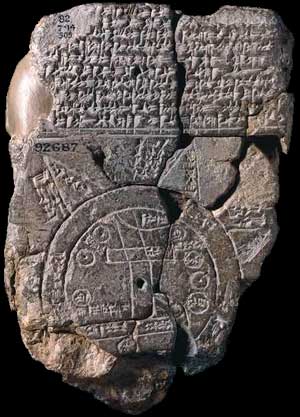
Babylonian World Map

Babylonian World Map and its Reconstruction

EGYPTIAN WORLD-MAP (Left)
Above the earth disc (which is drawn is seen from on high) lies the firmament (a pair of wings, and a goddess with outstretched arms, Nut). Both earth and firmament are overshadowed by the gargantuan body of Nu, who was the prototype of the great world-ocean which later ancient nations believed to surround Creation, as indeed she does in this pictograph. The earth disc is upheld by a sign whose feet and eye identify it as a personal power, ka. This earth disc is composed of three major rings — the two outermost rings contain symbols that represent ‘desert,’ ‘jackals,’ ‘subdued foreign lands,’ and ‘tomb,’ while the innermost ring is filled with forty-one signs (standards) of the Egyptian nomes. It therefore signifies Egypt, lying at the center of the earth — Othmar Keel, The Symbolism of the Biblical World
(The Seabury Press: 1978), pp. 37-39 & 42.
“Poseidon, the world-circler… We had attained the ends of the earth and its encircling river of Ocean… Here an endless night is spread over its melancholy people” —Homer, The Odyssey “I smile when I see many persons describing the circumference of the earth, who have no sound reason to guide them. they describe the ocean flowing round the earth, which is made circular as if by a lathe, and make Asia equal to Europe.” — Herodotus (Ancient Greek Historian and Explorer), Histories IV, 39 (Circa 500 B.C.)

But one fact that defeats all efforts to use Job 26:7 to prove sphericity is that Job was rebuked by God for opening his mouth in the first place! Compare the verses below:

Job Spouting Wisdom to His Friends

(Chapter 26)

Verse

(5) The departed spirits tremble under the waters and their inhabitants.

(6) Naked is Sheol before him and Abaddon (place of destruction) has no covering.

(7) He stretches out the north over empty space, and hangs the earth without anything, on nothing.

God Later Rebuking Job

(Chapter 38)

Verse

(16) Have you entered into the of the sea? Or have you walked in the recesses of the deep?

(17) Have the gates of death been revealed to you? Or have you seen the gates of deep darkness?

(18) Have you understood (or examined) the expanse of the earth? Tell me, if you know all this!

Other questions God asked Job were, “Where were you when I laid the foundation of the earthʼs (38:4); “On what were its bases sunk?” (38: 6) (Cf. “If the … foundations of the earth (can be) searched out below, then I will cast off … Israeli (Jeremiah 31:37).)

Obviously, Job 26:7 is a questionable proof of sphericity. Yet that is the key verse quoted by opponents of a flat earth interpretation of Scripture! Further attempts to discover spherical passages in the Bible are even less convincing. For instance, creationist Henry Morris asserts that another verse in Job implies the rotation of the earth: “(The earth) is turned as clay to the seal” (Job 38:14—King James Version). Morris says, “The figure, in context, is of a clay vessel being turned on a wheel to receive the design imprinted upon it by a seal or signet, like the earth as it turns into the dawning sun, gradually revealing the intricate features on its surface.” Of course this “rotating earth” interpretation of Job 38:14 is very modern (neither Luther nor Calvin, nor Mediaeval scholars in general knew of it). Moreover, Morris relies on the KJV translation without acknowledging that other translations do not fit his interpretation:

*It is turned as clay to the seal”—King James Version
”It is changed like clay under the seal” —Revised Standard Version

And, in context…

Have you ever in your life commanded the morning,
And caused the dawn to know its place,
That it might take hold of the ends of the earth,
And the wicked be shaken out of it?
It is changed like clay under the seal:
And they stand forth like a garment
And from the wicked their light is withheld,
And the uplifted arm is broken
(—New American Standard Version of Job 38:12-15)

According to these translations the earth is not turned like clay to the seal (KJV), but changed like clay under the seal (RSV and NASB), the clay most likely being in the form of an ancient writing tablet whose contours were changed under the seal of some magistrate, and not a clay vessel (cf. Morris) turned to the seal. Furthermore, there is evidence that in those days the Babylonians used cylindrical seals rolled on stationary clay. Either way, Morrisʼ unique interpretation of Job 38:14 appears far from proven.

Another argument of Morrisʼ is that Luke 17:34-36 implies “both the roundness and rotation of the earth.” Speaking of Jesusʼ second coming, the passage states, “In that night, there shall be two men in one bed; the one shall be taken, and the other shall be left. Two women will be grinding together… Two men shall be in the field”. “In other words”, says Morris, “this great event will take place instantaneously at night, in the morning. and in the afternoon. Such a combination would be possible only on an earth in which day and night could be occurring simultaneously, and that means a rotating earth suspended in space”. what Morris fails to notice is that Jesusʼ dictum that “No one knows the day or the hour” inspired Lukeʼs bedtime illustration. The point is, depending on when it happens, it might be like this, or like that. Besides, Morrisʼ argument was not proposed as such till after the rotation of the earth became an accepted fact. If here as elsewhere on Morrisʼ reading, the biblical texts teach modern cosmology, why did the church never notice it until the era of modern astronomy?

In conclusion, a flat earth interpretation of the Bible is not easily explained away. It remained popular even as late as A.D. 548 when a Christian monk, Cosmas Indicopleustes, composed one of the first “Bible-science” textbooks, Christian Topography, the first chapter of which was dedicated, “To those who, while professing Christianity, believe like the heathen, that the heavens are spherical”. (Cosmas, by the way, quoted Job 26:7 in his manuscript in favor of a flat earth!) Even today. the International Flat Earth Society continues to publish its newsletter, which includes Bible quotations similar to the ones discussed above. plus “scientific” reasons why people are fooled into believing that the earth is a sphere. They remind readers that believers in a flat earth have existed for over six thousand years, the extent of recorded history, and that the basis of the Real Christian Religion is that Jesus died, was resurrected, and then ASCENDED UP to HEAVEN ABOVE. But if the pagan idiocy. the ‘Grease Ball’ theory is true, then there is no UP, no HEAVEN, no ABOVE! And what interest could God have with a speck of dust among billions of bigger and better specks?”

How to Explain Away Geocentrism
Geocentrists get around flat earth interpretations by assuming beforehand that the Holy Spirit did not mean to teach flat earth science. How you answer the flat earth question thus depends on how much modern science you are willing to accept, and not on which biblical interpretation is superior. Geocentrists quote from the same Bible, a flat-earth-centered book, but explain away the flatness verses as metaphors, accepting only the earth-centered ones literally.

Example 1: Ecclesiastes 1:5 tells us that “The sun also ariseth, and the sun goeth down, and hasteth to his place where he arose”. So, according to Scripture, the sun moves. Read the Ecclesiastes verse again; it couldnʼt be plainer. Scripture also asserts that the earth stays put, or as John Calvin commented on Psalm 93 verse 1, “By what means could it (the earth) maintain itself unmoved, while the heavens above are in constant rapid motion, did not its Divine Maker fix and establish it? Accordingly the particle, aph, denoting emphasis, is introduced—‘Yea, he hath established it (the earth)’”.

Or take another passage. Joshua 10:12-13 states, “Joshua … said in the sight of Israel, ʻO sun, stand still at Gibeon, and O moon in the valley of Aijalon”. And the sun stood still, and the moon stayed, until the people had avenged themselves upon their enemies… So the sun stood still in the midst of heaven, and hasted not to go down about the whole day”. One of Martin Lutherʼs wily comments is appropriate here, “This man (Copernicus) wishes to reverse the entire science of astronomy; but the sacred Scripture tells us that Joshua commanded the sun to stand still, and not the earth.” Quite true! Joshua even commanded the sun to stand still at Gibeon, and the moon, in the valley of Aijalon, which suggests that he may have viewed them as diminutive bodies passing over specific valleys or geographical regions on earth!

Or take yet another passage. Psalm 19:4-6 depicts the sun “coming forth as a bridegroom from his chamber… rejoicing as a strong man to run its course. Its rising from one end of the heavens, and its circuit to the other end of them”. Notice that Scripture does not similarly depict the earthʼs movement, except during an earthquake, during which all creation shakes, both heaven and earth! Jobʼs earth “hanging on nothing” also appears to sit quite solidly in place.

In view of the fact that the ancients did indeed believe that the sun moved across the heavens (e.g. the Egyptian “boat of the sun”, or pictures of the Babylonian sun god rising from his mountain chamber and vaulting into the sky, and the ancient Greeksʼ astonishment when Anaxagoras suggested that the sun passing overhead may be as large as the Peloponnesus) it is not surprising to discover echoes of these beliefs in the Bible. The question is, how do nongeocentrists explain this away? Well, they explain them away the same way that geocentrists explain away the flat earth passages in Scripture, as “metaphors”, or descriptions for “appearancesʼ sake”, and not to be taken literally. This of course disturbs the geocentrists who report “The only way one can know for sure whether or not geocentricism is true is to leave the universe, look back, and then return to report whatʼs happening. Since only Godʼs knowledge is of such immense scope, what the Bible says must be ultimately true… For if God cannot be taken literally when he writes of the rising of the sun, then how can he be taken literally when writing of the rising Son?

Example 2: Besides the sunʼs movement, the Bible also depicts the starsʼ movement: “From heaven fought the stars, from their courses they fought against Sisera” (Judges 5:20). Of course to an earthbound observer the stars appear to follow wide circular courses through heaven each night. But another verse makes it clear that we are not dealing with mere appearances: “Can you lead forth the Mazzaroth (a constellation of stars) in their season (i.e., at the time of year they become visible, rising above the horizon), or can you guide the Bear (another constellation) with its children?” (Job 38:32). This is no mere appearance, for this verse states that God leads forth and guides the constellations (just as God is spoken of elsewhere as firmly establishing the earth). Leading and guiding are therefore actions that God performs. If God were teaching us that the earth moves, he would not have asked Job if he could lead forth or guide these constellations (in their season), but rather, if he could lead forth and guide the earth (in its season).

Again, speaking of a starʼs movement. Matthew 2:9 tells us that a star “went before (the wise men), till it came to rest over the place where the child was”. This is the tiny traveling star of Bethlehem. (It should be noted tangentially that attempts to make Matthewʼs star a conjunction of Mars, Jupiter, and Saturn would, contrary to the aims of apologists, tend to show that Matthewʼs account is mistaken, since he plainly viewed it as an actual star. And planetary conjunctions can no more move over the Judean countryside than stars can.)

Speaking further of the size of stars, notice what Mark 13:24-25 (Matthew 24:29) and Revelation 6:13-14 add: “The sun will be darkened, and the moon will not give its light, and the stars will be falling from heaven, and the powers in the heavens will be shaken” (Mark); “And the sun became black as sackcloth, the full moon became like blood, and the stars of heaven fell to earth as the fig tree sheds its winter fruit when shaken by a gale, the heavens vanished like a scroll that is rolled up” (Revelation). Iʼve read that these verses depict meteorites (or atomic missiles!) and not stars falling to earth, since modern astronomy declares that even the smallest star is immensely larger than the earth. But if you explain away these verses that way, their power vanishes. For the point is not that the earth, a tiny planet, is being bombarded by meteors or bombs, but that Godʼs creation is collapsing, the cosmos is coming to an end. This is precisely why God must create a new heaven (Revelation 21:1, 5). If anyone further disagrees that stars falling to earth cannot mean stars, he must also explain away Revelation 12:4 “His tail swept down a third of the stars,” already visible, and not meteorites, which become visible only as they enter the atmosphere, in which case “one third of” has no meaning.

So the Bible speaks of the end of the cosmos in tiny-falling-stars language, exactly as it speaks of the beginning of the cosmos, i.e., the tiny sun, moon, and stars “made” on day four, and “set” in heaven for the earthʼs light, seasons, and days (Genesis 1:14-18). Indeed, what can be made of a creation account that has the earth created ahead of the sun, moon, and stars? It certainly does not favor notions of the earthʼs movement. For what might the earth have orbited while it waited for the sun to be made? The obvious conclusion is that the Bible favors geocentricism (or flat earthism).

In conclusion, a geocentric interpretation of the Bible is not easily explained away—Martin Luther and John Calvin remained strict geocentrists even during the advent of Copernican astronomy! Geocentrism remained popular as late as 1650, when the scientific consensus shifted to heliocentricity. And today it lives on in the form of the Tychonian Society. According to them, “Historians readily acknowledge that the Copernican Revolution spawned the bloody French and Bolshevik revolutions …set the stage for the ancient Greek dogma of evolution … led to Marxism and Communism … and is thus a small step to total rejection of the Bible and the precepts of morality and law taught therein”. (Of course flat earthersʼ memories go back even further. For them, the evil was spawned once Christians accepted the ancient Greek dogma of a spherical earth.)

How to Explain Away Young Earth Creationism
Naturally, young earth creationists get around geocentric interpretations by assuming beforehand that the Holy Spirit did not mean to teach geocentric astronomy, just young earth geology. They quote from the same bible, a flat earth centered book, but explain away flat and earth-centered passages as “metaphorical”, accepting literally only those dealing with time. For in their opinion the creation of all the various planets and stars in the cosmos revolved conveniently around manʼs weekly time schedule, measured to six earth-days. What young earthers do not seem to realize is that this opinion fits ancient flat earth centered interpretations of Scripture better than modern Copernican ones. A day or even week on earth is no longer of any central value since the earth no longer occupies the center of the cosmos. It is merely one of nine planets whose “days” (as they spin on their axis around the sun) all vary considerably in length, with earth days no longer being centrally important for the measurement of cosmic time. Indeed, more modern and acceptable forms of time and space measurement are the speed of light and radioactive decay constants, which are true no matter what planet you inhabit.

Creationists are always trying to show how these scientific constants vary, but such efforts do not avoid the laughter that their own belief in a precise six earth-day creation generates. earth-day creation generate. For daytimes or weekly times (i.e., approximately one quarter of the lunar cycle) experienced on earth naturally appear central to earth dwelling beings (but obviously not to the cosmos at large); just as the earthʼs situation in space appears central to earth dwellers gazing at celestial “movements” overhead, and the earthʼs flatness appears obvious to earth dwellers gazing at the horizon. In each case who is to decide which interpretation is of cosmic significance, or only of “apparent” significance? Was the cosmos—sun, moon, and stars, earth, etc.-created in six earth days? Did God really spend five of those days setting the earth in order, its waters, land, vegetation. animals, etc.. and spend only one earth day making the sun, moon, and stars? He didnʼt waste much time on the rest of the cosmos, did he?

Anyone who has studied young earth creationist interpretations of the Bible has noted that they, in turn, are just as difficult to explain away as flat earth and geocentric interpretations.

Example 1: Genesis chapter 1 states that God completed his creation in “six days”, each consisting of “an evening and a morning”, after which God “rested” on the “seventh day”. Moreover, “God blessed the seventh day, and sanctified it, because on it God rested from all his work which he had done in creation” (Genesis 2:3). Exodus 20:8-11 adds, “Remember the sabbath day, to keep it holy. Six days shalt thou labor, and do all thy work: But the seventh day is the sabbath of the Lord thy God…For in six days the Lord made heaven and earth, the sea, and all that is in them, and rested the seventh day: wherefore the Lord blessed the sabbath day, and sanctified it.” The point of dividing the creation process into days, a feature that could easily be omitted without affecting the sense of the story, is to reinforce sabbath observance. These days of creation were therefore accepted as normal days of the week by the ancient Hebrews.

Old earth creationists, dissatisfied with such an interpretation, point out that the Hebrew terms for “day” and days are also used in scripture to depict indefinite periods of time, as in “the day(s) of” a particular king or patriarch, or the “day” in which God created The heavens and the earth (Genesis 2:4). Other verses declare that a “day” in the Lordʼs eyes may be a thousand years in manʼs (Psalm 90:4; Peter 3:8). So who knows how long one of Godʼs “days” may be? Speaking of the establishment of a sabbath “day” of the week, old earthers add that God also established a sabbath year (Exodus 23:10-11; Leviticus 25:3-7), and a jubilee sabbath—every seventy years (Leviticus 25: 8-17), which suggests that the emphasis on the sabbath is rest instead of the strict interpretation of days. In fact, the author of the Epistle to the Hebrews speaks of entering into Godʼs “rest”, viz., the “seventh day” of creation, adding, “Since it remains for some to enter it, and those who formerly received the good news failed to enter because of disobedience, again he sets a certain day, ‘Today’” (Hebrews 4:6-7a). So, the author of Hebrews employed an allegorical interpretation of the “seventh day” of the Genesis account.

Other questions raised by old earth creationists are (1) Since the sun was not made till “day four”, and the length of a “day” on earth depends on its axis spinning in respect to, sun, how can we on its axis spinning in respect to the sun, how can we be certain of the length of the three pre-sun “days” in Genesis? And (2) since each “day” in the creation account is not a traditional Hebrew “day” measured from evening to evening, but from “evening to morning” (Genesis 1:5, 8, 13, 19, 23, 31), it could be that the account represents seven daily awakening or visions granted the author of Genesis. Thus, the “days” may have nothing to do with the duration of creation so much as with the “evening to morning” periods during which the visions were received. Moreover, the “evening and morning” in Genesis make a night, not a day, if one wants to press the literal interpretation of these two items.

Nevertheless, the attempts of old earth creationists to squeeze out an old earth interpretation from Scripture remain less convincing than the plain interpretation accepted by the ancient Hebrews themselves, as in Exodus 20, cited above. For the days in Genesis 1 are numbered, consecutive periods of light and darkness that add up to manʼs work week. That one of the Lordʼs days may be as one thousand years for man is true insofar as God stands above time, but this adds nothing to the plain interpretation of “days” in Genesis. Notice that on the fourth day the meaning is obvious literal, since the very purpose of the sun and moon is said to be to rule the “day” and “night”. Old earth creationism would only appear reasonable if the Hebrew word olam (meaning “long, indefinite time”) appeared in place of the Hebrew word for “day”. And, though the author of Hebrews did cite the “seventh day” allegorically, this does not conflict with a literal belief in a “seventh day” of creation, nor does the existence of a sabbath year, or jubilee sabbath. These are all obviously intended as secondary applications of a literal original. And finally, there are no hints within the text that it is referring to a revelation received over a period of seven days.

A young earth creationist interpretation of the Bible is not easily explained away. And there are further difficulties with old earth creationism.

Old earth interpretations of Genesis 1 are of two major types, the Gap Theory and Day-Age Theories. According to the Gap Theory, the description of the “waste and void” earth in Genesis 1:2 is of an earth that “became” that way. This earth was Godʼs first creation, which grew to be very old (as modern geology demonstrates), then was made “waste and void” by Satan. Gap theorists say that verses after Genesis 1:2 tell of the earthʼs recreation, which took six literal days. and occurred a few thousand years ago. This is quite a “gap” in the creation account; it is based primarily on an alternate translation of a single Hebrew verb: Gap theorists insist that Genesis 1: 2, on their reading, does not say that the earth “was” waste and void, but that it “became” waste and void. Notice, the gap between creations also swallows the entire geological past including Neanderthal and Cro-Magnon men found in the fossil record. Yet scripture says that Adam was the first man, and not a recreation of man (Genesis 2:4-7); Mark 10:6; Romans 5:12-14; I Corinthians 15:45; et al. And since the Gap Theory does not call into question the vast cosmological age and geological evidences of the “first” creation, we must suppose it took shape over vast ages of progressive creation, none of which the Bible mentions. However, the Bible has much to say about its “recreation” which took only six days!)

Recently, among old earth creationists, the Gap Theory has become less popular than Day-Age Theories. The first basic Day-Age Theory the Overlapping Day-Age Theory, assumes that the “evening and morning” of each days in Genesis 1 are purely symbolic of the “beginning and end” of vast creative periods that overlap in geological time. The “days” are thus interpreted as vast ages in which were created the earth, sun, moon, and stars (day 1), the earthʼs atmosphere and oceans (day 2). the earthʼs dry land and vegetation (day 3), the clearing of the earthʼs atmosphere to see the sun, moon, and stars (day 4), the earthʼs air and sea animals (day 5), the earthʼs land animals and man (day 6). (Obviously, even accepting such an interpretation, billions of years of cosmological time, and the formation of billions of stars and galaxies zip by on “day 2”. And Godʼs attention appears to be focused purely on the earth.)

The second basic Day-Age theory, the Modified Intermittent Day Age Theory, assumes that each “evening and morning” refers to an actual day that introduces a vast period of creative activity, till the next “introductory” day. The Day-Age sequences of this theory do not differ from those outlines above. (Notice that Day-Age theorists cannot admit that the “sun, moon…and stars” were “made” and “placed” in the heavens on “day four” (Genesis 1:16-17) since modern astronomy teaches that most stars and galaxies evolved far earlier than the midpoint of the earthʼs geologic ages. Besides, modern geology teaches that the sun and moon are certainly as old as the earth. Therefore, day-agers explain Godʼs activity of “day four” as a “clearing of the atmosphere” to see the sun, moon, and stars, which they say were created on day one. However, the perspective behind the creation account is not that of an earthbound observer, i.e., one who sees the sun, moon, and stars through a “clearing atmosphere”. Rather, the perspective is Godʼs. He announces, let there be lights…” and God made the two great lights… the stars also, and God placed them in heaven, etc.)

Day-Age theorists also have to face difficulties caused by Godʼs gift of green plants for food for every living creature. For the creation account states that after God made the beasts of the earth and man on day six, he gave man “every plant yielding seed that is on the surface of all the earth, and every tree which has fruit yielding seed; it shall be food for you; and to every beast of the earth and to every bird of the sky and to everything that moves on the earth which has life, I have given every green plant for food” (Genesis 1: 29-30). Thus, Godʼs (land and sky) creatures were all vegetarians! Modern geology, on the other hand, teaches that flesh-eating creatures of land and sky have existed for hundreds of millions of years. For instance, fossil dung of prehistoric land animals, preserved because of the relative stability of its components, contains fragments of bone, teeth, and hair. Moreover, we know that the amount of strontium incorporated in the bones of vegetarians will be higher since the strontium concentration in the plants they eat is relatively high, while in carnivores the amount is lower, since they eat the vegetarians who have already concentrated the strontium in their bones (and no place else). Therefore, carnivores do not absorb as much strontium in their bones, even after chewing the vegetarianʼs bones, which are simply eliminated. By comparing levels of strontium found in fossil (bone) remains of sharp-toothed-clawed creatures (presumably carnivores) with flat-toothed-husky creatures (presumable vegetarians), we can clearly see that carnivorous animals long antedated man. Prehistoric tools like spear points, axe heads, etc., also support the contention that prehistoric man hunted live game. What then becomes of the Genesis statement that every green plant was given to every land and sky animal for food?

Perhaps the most untenable aspect of Day-Age Theories is their acceptance of the antiquity of man, plus the genealogical record in Genesis tracing manʼs ancestry to Adam. They suggest that gaps exist in the list of names of Adamʼs descendants, gaps that accommodate the geological date of manʼs earliest appearance on earth. This is a difficult accommodation since modern geology teaches that Archaic forms of Homo sapiens first appear about 500,000 years ago (the term covers a diverse group of skulls which have features of both Homo erectus and modern humans), while the genealogy in Genesis (chapters 5 and 11) contains only twenty names, i.e., from Adam (the first man), to Abraham (“historical” man). Thatʼs an average “gap” between names of at least 25,000 years! But what conceivable purpose can there have been in carefully recording the age of each father at the birth of some unknown son who was then to be merely the remote ancestor of the next individual named on the list some 25,000 years in the future? Who ever heard of such a “genealogy?” Obviously, minor gaps may occur in the lists, such as we later find in Matthewʼs selective genealogy of Jesus (Matthew 1:1-17). But it is significant that the reliable historical records of ancient civilizations begin only a few thousand years ago (even as the biblical chronology of Genesis 5 and 11) and hence read without such lengthy “gaps.” This would suggest by analogy that the genealogy in Genesis intends to chronicle a cosmos that is only a few thousand years old, going right back to Adam.

Thus, old earth creationism fails to satisfy both the Bible and modern science and falls into an unbridgeable “gap” of its own.

Bible-science? Or Concessions Made to Modern Science?
As we have seen, the Bible contains no unequivocal verses depicting the earthʼs sphericity, its movement, or its non-centrality in terms of cosmic time. Rather, the young earthʼs flat firm centrality is affirmed throughout the Bible. The arguments employed to explain away young-flat-earth-centered verses reflect increasing concessions made over the ages to advances in our knowledge of astronomy, geology, etc., rather than adherence to biblical teaching. Typically, the arguments for a spherical earth, a moving earth, and an old earth were “discovered” in Scripture only after each of those facts had been first established by scientific means. I hope to have demonstrated to my readers that only two consistent choices face Christians embroiled in the creation/evolution controversy: slipping down to the bottommost circle of pseudoscientific “hell” to join the flat earthers, who allow the Bible to speak for itself; or recognizing with theistic evolutionists that the prescientific cosmology of the Bible forms no part of its message of salvation.

BIBLIOGRAPHY

  • Flat Earth
    Cosmas Indicopleustes. ca. 550 A.D. Topographia Christiana.
    Trans. J. W. McCrindle. London: Hakluyt Society (1897).

  • Flat Earth Newsletter. Lancaster, CA

  • Geocentric
    Gerardus D. Bouw. Every Wind of Doctrine.
    Bulletin of the Tychonian Society. Cleveland, OH

  • Young Earth
    Henry M. Morris. The Biblical Basis for Modern Science. Grand Rapids, MI: Baker Book House, 1984.

  • Institute for Creation Research, El Cajon, CA

  • Old Earth
    Pattle Pu. Evolution: Nature and Scripture in Conflict?
    Grand Rapids, MI: Zondervan, 1984.
    Interdisciplinary Biblical Research Institute. Hatfield, PA

  • Theistic Evolution
    Conrad Hyers. The Meaning of Creation Atlanta, GA: John Knox Press. 1984.

  • Theistic Evolutionistsʼ Forum, Greenville, SC

  • Cosmologies and Cosmogonies of the Ancient Near East
    Ed Babinski. Does the Bible Teach Scientific Creationism? 1984.

Edward T. Babinski Speeches

Speech #1

Filmed February 17, 1990 Ed Babinski speaks to an audience on Flat Earth Creationism.
This first speech, on the Biblical shape of the earth, was delivered before a group in Columbia, South Carolina, the “South Carolina Academy of Religion,” that meets once a year, an informal group of religion professors, educators, and ministers.

Edward Babinski

Speech #2

The second speech was on the Biblical age of the earth and evolution, delivered before the Greenville, Secular Humanists of Greenville, S.C. This speech addresses the basics of the Creation-Evolution controversy, including a variety of discussion on Human-Chimp chromosomes and Pseudogenes, Geology and fossils.

Download Challenge to Kent Hovind by Edward T. Babinski.
Download stored in zip format.
Zip file includes "https://edwardtbabinski.us/videos/babinski-hovind.wmv"
Requires Windows Media Player
Total File Size: 4.82 Megabytes
Duration: 2 Minutes, 32 Seconds
Challenging Kent Hovind to explain fossils in the geological record and similarities between human and chimp chromosomes, including Pseudogenes.


Hellbound Allee

Download Interview on Hellbound Allee
hellbound.zip contains "https://edwardtbabinski.us/videos/hellbound.mp3"
(Edited from the original hour long broadcast)
Size: 4.86 megabyte
Duration: 42 minutes 28 seconds
Original broadcast date: March 12, 2005


babinski_01_1990.flv 52,998 k
speech-01.wmv
File Size: 6.95 Meg
Duration: 28 Minutes 36 Seconds

babinski_02_1996.flv 59,763 k
speech-02.wmv
File Size: 7.87 Meg
Duration: 32 Minutes 28 Seconds

Science and Scripture

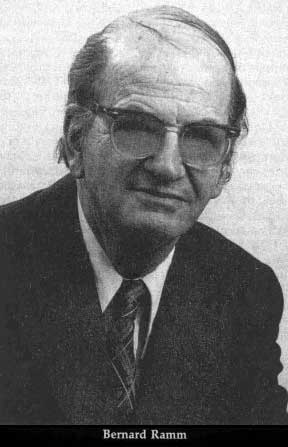
Although Ramm presents it as a “prediction” it is not much of one since he says there were already were at least 55 fossil hominids in his day:
“It has been incorrectly asserted that the fossil remains of man are few and fragmentary. It is argued that from a small basketful of enigmatical bones an entire evolutionary history of humanity is constructed. This might have been the case a half-century ago but it is no longer a valid objection. There are fifteen skulls or fragments of Sinanthropus Pekinensis, and of other prehistoric men there are as many as forty skeletons. For one Piltdown skull which must be given up there are one or two dozen to take its place. Dr. Broom has scurried around South Africa with great zeal, turning up numerous skulls. If a hundred Dr. Brooms were to work as diligently in all the world we might well fill a museum up with prehistoric human fossils. Evangelicals must seriously reckon with this as a real possibility and be prepared for it. The anthropologist cannot be discounted any longer on the ground that all he has to work with is a basketful of controversial bones.” (Ramm B.L., “The Christian View of Science and Scripture,” [1955], Paternoster: Exeter, Devon UK, 1967, reprint, p.216)
Science and Scripture

Gish of course was not impressed by Rammʼs list at the time Ramm made it above, and hence Gish scorned both Peking Man and Piltdown. And Australian creationist Quote Book boasted until recently that “there were barely enough remains of early man to fill a coffin.” It wasnʼt until 1994 that I read about young-earthers Agreeing With Ramm and saying things like:

“I was surprised to find that instead of enough fossils barely to fit into a coffin, as one evolutionist once stated [in 1982], there were over 4,000 hominid fossils as of 1976. Over 200 specimens have been classified as Neandertal and about one hundred as Homo erectus. More of these fossils have been found since 1976.” Michael J. Oard, in his review of the book, Bones of Contention
— A Creationist Assessment of Human Fossils, in the Creation Research Society Quarterly, Vol. 30, March 1994, p. 222

“The current figures [circa 1994] are even more impressive: over 220 Homo erectus fossil individuals discovered to date, possibly as many as 80 archaic Homo sapiens fossil individuals discovered to date, and well over 300 Neandertal fossil individuals discovered to date.”
Marvin L. Lubenow, author of Bones of Contention
— A Creationist Assessment of Human Fossils, in a letter to the editor of the Creation Research Society Quarterly, Vol. 31, Sept. 1994, p. 70

But Ramm said a lot more about it than that. He had a whole chapter on Anthropology and showed how the Bible and science could be interpreted harmoniously with the right *attitude* on the part of both scientists and Christians:
“B. Certain features which we tend to overlook.
1. Both geology and Scripture teach that man is the latest major form to appear on the earth.

I fully agree, in terms of sheer intellect man is the latest major form to appear on earth. But what about in terms other than sheer intellect? Depends on how you define “forms” and “major” I suppose. Genomically speaking, the change from the common ancestor of chimp and man —< to manʼs genome, did not involve a genomic change of “major form.” I bet there are plenty of creatures who have undergone greater changes in their genomes over the last five million years, notably creatures with quicker reproductive cycles than man, or creatures living in regions where mutations appear more often.

As for man appearing “last or latest” that remains a point of Biblical contention between old-earth creationist and theistic evolutionist Christians at ASA, because what “Scripture teaches” about the timing of manʼs creation is not without contention when you compare Gen. 1 and 2. Was man created first or last? Thereʼs at least one article and discussion of that topic, which is still debated at the ASA site.

As for the account of Genesis 1, taken by itself instead of compared with Genesis 2, yes, Gen. 1 says man was created last, and it also says that God rested after that. Exodus added that God “rested and was refreshed” after his six days of creation, which some translators say literally means, “rested and caught his breath.”

2. Anthropology and Scripture agree that man is the highest form of life. In Biblical language, man is in the likeness and image of God. Scientifically considered, man has
  1. the most generalized body of any organism
  2. the largest brain in ratio to the weight of the body and diameter of the spinal cord
  3. the most complex brain and,
  4. is the most intelligent of all life.

Yes, we have big brains and spinal cords, on the other hand as soon as any creature evolves that can write books, including both holy books and science books, it will recognize itself as the highest creature around, after all, it holds the pen. As far as evolving “last,” evolution doesnʼt say man came “last.” It just says that man arrived. Who knows what is going to evolve “last” (especially if you consider that the world might go on for billions of years, and that there might also be life on other worlds).

3. Anthropology and the Bible both assert that man has much in common with the animals. The Bible asserts that the animals were made from the earth (“let the earth bring forth”), and that man was made from the dust of the earth. The strong emphasis in modern science on the continuity of manʼs body with the animal world is but the realization of what is in the Biblical account already.…

Compare the proportion of different atoms and molecules in your average patch of earth with the proportion found in the human body, the latter of which is over 60% water. It would be nearer to scientific accuracy if the Bible said man was created from water than from earth. In fact manʼs blood contains similar (not exact) minerals to sea water. Also earth and clay contain loads of silicon, while manʼs body is carbon based. And of course, if you want to stress “continuity” as Ramm does above, why not point out the continuity in evolution rather than the continuity of both being created “from earth,” i.e., the fairly small genomic differences between man and chimp, which are as close as sibling species of near identical fruit flies? But the Biblical author knows nothing of this, to the ancients there were basic “elements” like earth, water, fire, air. So he had to choose among those to create man and beasts from. And he chose “earth.”

I happen to think man and the beasts were not separately and specially “created from the earth,” but from each other. And indeed if you went back far enough we even shared fish-like ancestors, which the Bible claims were created on totally separate days from the beasts of the field.

Mivart asks us to contemplate what we would do, as it were, if we were God and were going to create man. He says we would be guided by these considerations: (i) to live on his earth man must resemble animals in that he must eat, breathe, etc.;

Yes, we must eat, so what about the bacteria that infect the food we eat? Microgram for microgram, the poisons produced by some bacteria in our food are more potent than all other known poisons on earth. It is estimated that one tenth of an ounce of the toxin produced by bacteria causing botulism would be more than enough to kill everyone in the city of New York; and a 12-ounce glassful would be enough to kill all 5.9 billion human beings on the face of the Earth. (The same happens to be true of the toxin that causes tetanus.)

(ii) being an intelligent creature he must have a large nervous system; (iii) as such, no invertebrate nor reptile nor fish nor bird is so built as to be able to support such a huge nervous system;

Any creature with any system whatsoever is “built to support it” to one degree or another. Though the fact that the human pelvis is has narrowed with upright posture and the human infantʼs skull is larger in man than other primates does make birthing difficult for the human species:

Only a Designer would have had the infinite wisdom and compassion to create human beings as two-legged upright creatures based on the same skeletal design for four-legged creatures. This has led to innumerable problems for men and women. Aside from lower back pain, foot, ankle, and knee problems, “to effect upright posture based on the skeletal system of four-legged animals the human femaleʼs sacrum had to be pushed down somewhat, so that its lower end is now below both the hip socket and the upper level of the pelvic articulation…
This has resulted in an encroachment on the female pelvic cavity, thereby narrowing the birth canal and rendering it too small for comfortable birthing. The result is that human childbirth is generally painful and often dangerous. The process of giving birth exposes both the mother and her infant to sizable risks of accidents and infections. For a woman with a small pelvis the rigors of childbirth can be excruciating, even fatal. No other animal has this problem.” [Wilton Krogman, “The Scars of Human Evolution,” Scientific American, 1951 - as cited in Timothy Andersʼ The Evolution of Evil]

Only in recent times has the mortality of women and children during childbirth been greatly reduced due to advances in obstetrical medicine. Even today, however, a womanʼs chances of dying from complications during childbirth remain greater than dying from complications due to having an abortion during her first trimester of pregnancy. If only the Designer had employed a uniquely improved design instead of just jury-rigging the old four-legged skeletal system to make us walk erect!

Speaking of another flaw (albeit a minor one compared to the above), designed into the upright skeletal system of human beings are “two major blood vessels, going to the legs, that must cross a sharp promontory bone at the junction of two lower vertebrae in the spine. The organs in the pelvis exert great pressure on those two blood vessels. During pregnancy, this pressure may build up to such an extent that the vein is nearly pressed shut, making for very poor blood drainage of the left leg. This is the so-called ‘milk leg’ of pregnancy. Four-legged animals experience no such problem.” [Wilton Krogman, “The Scars of Human Evolution,” Scientific American, 1951 - as cited in Timothy Andersʼ The Evolution of Evil]

But overall, any living creature with any system whatsoever is supported by that system and vice versa, or the creature dies, a fact that both creationists and I.D.ers and Darwinianʼs agree upon. Now please explain creatures that are awkwardly built or that exhibit atavisms like legs on modern day whale fetuses and whales. Or like toes on pigs that donʼt touch the ground as they walk? Or like giraffe babies falling several feet and landing on their heads at birth? Iʼm sure the explanation is that “they had to be created that way, because of natural limitations within creation itself.” Well, Darwinism also agrees there are natural limitations, and that creatures evolving in certain directions are impeded to various degrees by the directions they have evolved in. So Mirvatʼs arguments seem to prove very little when you think about them. Similar arguments work for all sides. (Thatʼs why I donʼt like to categorize myself as either an I.D.er nor a Darwinian, I still have questions. I just happen to be asking them of I.D.erʼs more often these days. My own personal hopes as I have said are of a higher power and an afterlife, based perhaps on the anthropic principle and perhaps also on some arguments in Dentonʼs second book.)

(iv) whales, porpoises, and seals are ruled out as they lack large enough nervous systems, and for the same reason we must (v) rule out the hoofed animals;
(vi) this restricts us to the carnivores, and among the carnivores those who have a body most closely suited to what man should possess are the simians. The many traits that man has in common with animal life, and his marked similarities to the simians, should come then, upon mature reflection, as no great surprise.

And equally no great surprise either to creationists nor to evolutionists, which again proves nothing.

4. Geological and anthropological evidence is not the only source of our information about manʼs origin. Manʼs nature investigated through psychology and reflected upon in theology and philosophy, is also evidence as to his divine origin. It is not possible to account for manʼs great intelligence, his conscience, his spiritual experiences, his artistic creations, on purely naturalistic premises.

Who really knows how to account for everything? Naturalists canʼt account for everything and admit it, but theists account for reason by positing Divine Reason, and they account from design by positing a Divine Designer, and they account for artistic creations by positing a Divine Artist, and they account for intelligence by positing Divine Intelligence. Sounds like the theists are accounting for everything simply by using the same word and capitalizing it. Kind of like circular reasoning. So neither naturalist nor theist has a step by step account of everything. Though naturalists, especially methodologically speaking seem more inclined to inquire into questions in a step by step fashion rather than positing the same thing and capitalizing it.

There is a divine element detectable in human nature now which indicates a divine origin of man in the past. Only the Biblical account which asserts the double origin of man (from dust, from God) is true to the total man. Any present conflict between Genesis and anthropology does not obviate the fact of a present and detectable divine element in human nature, and therefore the necessity of a divine origin of the divine element in that human nature.

Edward: Every major religion, even ones without Genesis-like creation accounts, seems to agree that there is something divine in man, something that is eternal.

5. Perhaps our problem is interpretative. Maybe our trouble is that we are trying to apply modern methods of historiography to a method of divine revelation which will not yield to such a treatment… Until we get further light from science or archaeology we must suspend judgment as to any final theory of the harmonization of Genesis and anthropology …

(Ramm B.L., “The Christian View of Science and Scripture,” [1955], Paternoster: Exeter, Devon UK, 1967, reprint, pp.229-230)

I like that! Suspending judgment. Seems very reasonable to me. Ramm just cited the broadest outlines of a few basic “harmonies” between science and scripture, though I even question some of his points. He is also brave enough to mention “present conflicts between Genesis and anthropology” in point four. Yes, I too see the conflicts, and the non-special nature of the Genesis account, “historiographically” speaking.

From YEC (Young Earth Creationist) to Evolutionist

Edward T. Babinski

“Edward Babinski”
Date: 5 Jul 95

O.K. folks, hereʼs my former fundie story in a nutshell…

I was confirmed Catholic, stopped going to mass, then was “born again” after reciting the “sinnerʼs prayer” with my best friend at the time (we were in high school). And I began attending an independent fundamentalist church in town that was known for having a great preacher, Pastor Earl V. Comfort. I was rebaptized.

In college I was elected president of the most evangelical group on campus. I got into the charismatic scene, living room meetings, and Anglican charismatic prayer meetings. I also studied all the Christian apologists I could get my hands on, to try and convince fellow students and professors of the truth of Christianity. I read everything by C.S. Lewis, G.K. Chesterton (about thirty books in all), all of Francis Schaeffer, some Os Guiness, Josh McDowell, and some Reformed Presbyterian writers too (who believed in the strictest “presuppositionist” apologetics). So, it was difficult for me to think my way out after having “thought my way in” so deeply.

I began corresponding with two former evangelical friends, both of whom had left the fold in college. One had opened up to a more mystical universal belief, and the other had read about two hundred or more volumes of historical criticism and was getting his Ph.D. in N.T. Theology. I was caught between a rock and a hard place. We exchanged probably over three hundred letters at this time, and about halfway through our discussion I began to read some of the books both of them suggested. My eyes were opened. Slowly at first. I tried holding onto a more moderate and liberal evangelicalism, a al Robert Farrar Capon and Alan Watts (the books written when he was still an Anglican minister), and Conrad Hyers (the humorous spiritual writer). But to no avail. One of the final breaks occurred after reading Thomas Paineʼs little monograph on the prophecies, and reading a Jewish scholarʼs book that also pointed out that the early Christians were lying about what the Old Testament plainly stated, in order to make it conform to “Jesusʼ life.”


From: Ed Babinski
Date: 5 Jul 95
Subject: RE: Leaving the Fold

[Toronto Blessing]

Isnʼt the “Toronto Blessing” the “laughter blessing?” Just wondering. I was a charismatic for a while, and can still speak in tongues whenever I wish. I believe Rob Berry can too. Just a note to let you know that thereʼs two books written by a former Pentecostal minister, one of which is called Donʼt Call Me Brother, which discusses a lot of the different “blessings” in the charismatic/Pentecostal genre which made the rounds at Jim and Tammy Bakkerʼs religious amusement park. An edited version of Donʼt Call Me Brother is found in my own recent book, Leaving the Fold: Testimonies of Former Fundamentalists, by Prometheus Books, copyright 1995, hardcover, 460 pages, acid free paper, photos, index, retails for $32.95 (USA)

Leaving the Fold includes over 30 testimonies by former fundamentalists who are now either moderate evangelicals, liberal Christians, ultra-liberals, Wiccans, mystics, agnostics, or atheists. They tell their own stories, just as they wish, explaining how they entered into fundamentalist Protestant Christianity, and why they left it. Itʼs a book for anyone seeking to understand their faith more and struggling with it, be they Christians, atheists, or members of other religions.

One testimony is by Charles Templeton, Billy Grahamʼs best friend during the Youth for Christ years, and a former fellow evangelist. Today, Templeton is a “reverent agnostic.” And thereʼs Sam Keenʼs story (he is the author of Faces of the Enemy, which was also a PBS special), and some historical figures like Americaʼs “Great Agnostic” (Robert Ingersoll), and H. P. Smith the Presbyterian biblical scholar who was booted out of his denomination in a famous “heresy” trial, and modern figures like the moderate evangelical Christian editor of The Door (a sort of Christian National Lampoon), Mike Yaconelli (who went to the fundamentalist institution, Bob Jones University), and Farrell Till, former Church of Christ minister and now editor of The Skeptical Review. Thereʼs a big bibliography with lots of other places to look for further testimonies, an appendix of quotations regarding fundamentalism, an extensive index, and a section on the history of fundamentalism which explains how liberal fundamentalism has grown over the centuries!

Phone Prometheus Books for a free catalog, at 1-800-421-0351 (24 hours).

Best, Ed B


I would be interested in hearing more about Edʼs “intellectual journey”. In particular if he went fairly directly from YEC to “liberal evangelicalism”, or did he pass through an extended “old-earth” Progressive Creationism stage? If so, what OEC/PC books did he read during that stage, and what were his main problems with them?

LOL (at “extended” old-earth stage — an unwitting pun perhaps?) Iʼm afraid that my old-earth stage did not drag on as long as that of say, Glenn Morton who went from young-earth to a “middle-earth” stage(no, not Tolkeinʼs middle earth but his compromise with the fact the he wanted an earth was young as he could get it, but honestly couldnʼt find arguments that would bring it down under a couple hundred thousand years old), which he maintained for a while before finally becoming an old earther (an earth billions of years old)

Source: Glenn Morton

I was still a young-earther after I graduated from college with a B.S. in biology, after which a moderate/liberal Christian friend (he was moderate but grew more liberal over time) lent me Bernard Rammʼs book on The Harmony of Science and Scripture to read, and also lent me the special “Noahʼs Ark” issue of Creation/Evolution journal (I think that the National Center for Science Education on the web still has copies of them for sale). I read both of them, and recall being affected by Rammʼs admission that more and more early ape and hominid skulls were being dug up every year. Ramm proved correct about that prediction, even though he wrote it in the 1950s. The “Noahʼs Ark” issue of Creation/Evolution was my introduction to questions being asked of the Noahʼs ark story and of Flood geology. Prior to that I thought all the questions were being raised concerning modern geology. With the aid of those books I began to understand that my own side contained “difficulties” rather than simply all the difficulties lying on the side of old-earthers and evolutionists. I canʼt remember all the old-earth books I read, but two by Dan Wonderly stand out, his early work, Godʼs Time Records in Ancient Sediments, and also his later work, Neglect of Geologic Data (taking the young-earthers to task, Wonderly built his old-earth arguments on phenomena that take a lot of time to form, like fine clay particles that require still water and a lot of time to settle and yet thereʼs shale deposits from clay many feet thick sandwiched in places in the geologic record. And the time it takes microscopic organisms to form microscopic calcium-rich “shells” and then die and have their shells settle on the waterʼs bottom and form limestone many feet thick, even pelletized limestone from the fecal pellets of fish who ingested the microscopic organisms and then their fecal pellets collected in layers many feet thick. And the time it takes corals to grow and where they are found in the fossil record in situ, and other such arguments. Danʼs evangelical commitment and reasonable arguments even somewhat moved Henry Morris the young-earther because in Morrisʼs early works, Danʼs books are the only “old-earth” books Morris mentioned in his bibliographies. Of course at that early time, when Morrisʼs book, The Genesis Flood was just catching on in the mid-60s and early 1970s among conservative Christians, there were not a lot of geologists who thought it seemly to devote time to answering Morrisʼs arguments. Dan was one of the first to point out that Morris assumed trilobites were heavy creatures and hence sunk to the bottom of the Floodʼs “geologic column” very fast, but Dan corrected Morris and pointed out that paleontologists actually assumed that trilobites were probably as light as todayʼs sandcrabs. (I wonder if Morris assumed that a fossil of a creature was as heavy as the creature itself in the case of trilobites? Quite a blind spot Iʼd say, whatever Morrisʼs reasons.)

I have also read some other old-earth works, including one by Pattle Pun, and Alan Haywardʼs book, Creation and Evolution, and John Weisterʼs book on Genesis 1 and science.

What problems did I see with old-earth books? None concerning the old-earth science they contained. It was their attempts at a scientifically accommodating theology that I began to have a problem with. I knew the young-earth reasons for assuming that the creation account spoke of six literal earth days with evenings and mornings, even linked to manʼs work week in a verse in Exodus. And although I had read a number of attempts to harmonize the Scriptural account of creation with an old-earth, none of them seemed convincing. I mean, fruit trees created a day before the sun moon and stars? (Yes, I knew of the old-earth harmonization attempt that declared the sun, moon and stars “appeared” on day four as seen by an earthly observer through a sky in which the clouds had just broken, so it was argued, they were not “made and set” as it literally says in Genesis on day four. But to make the harmonization work you have to neglect the plain words that they were “made and set into the firmament above the earth.” And you have to delegate day four of creation as a day when God did little, a day of “rest” in the Middle of the creation week when He simply let the clouds roll by.

I also began to research the comparative ancient near eastern history of the Genesis creation account (writing a manuscript, “Does the Bible Teach Scientific Creationism?” that I sent to Dr. Henry Morris my former young-earth hero), to tell him that I had found nothing scientific in the Genesis account, nor in a lot of other verses in the Bible where I had previously seen “modern science in the Bible.” Instead, I began to see the creation week as a reflection of the ancient notion of the earthʼs primacy, everything created in earth days, in earth evenings and mornings, everything created for the earth, with the sun moon and stars as light bulbs made and set above the earth only after the earth was brought forth first, and to light the earth and for signs and seasons on the earth below.

Then came the creation of the fish and birds a day before the creation of land critters. Fish and birds together? This was apparently done to fill the two regions created after the waters were divided on day two, the sea and the sky “and the birds flew across the face of the firmament.” So Day Two of Creation parallels Day Five. But it seemed to me a poetic parallel having little to do with the actual order of appearances of creatures in the geologic record with fish first, then land animals, and birds later. And what about creating fruit trees and seed-bearing plants three days before creeping things (including the pollinating insects that such plants required).

Those are some of the problems I began having with the Biblical creation account, it was strictly a miraculous account with the earth being primary in creation with everything created for it alone, and in six earth days. The parallels between the Bibleʼs account and other ancient near eastern accounts were stunning and striking, especially in the ways they all assumed a flat earth and the earthʼs primacy in all of creation with the heavens created just for the earth and after it, and animals created by divine fiat out of the ground.

Such realizations led me at that time to abandon trying to harmonize Genesis with modern science, though I had read a number of attempted harmonizations. And there was the added difficulty of harmonizing the sequence of Gen. 1 with Gen. 2, since Gen. 2 seems to reverse certain sequences in Gen. 1.

The articles of the evangelical Christian Paul Seeley have served to convince me further that Genesis is not dealing with science at all. Seeleyʼs articles questioned a lot of old-earth attempts at harmonization, like his article on “Concordism and Genesis 1.” He is a member of ASA, an evangelical group of Christians who work in scientific fields, and his articles have appeared even in the conservative Westminster Theological Journal (Seeleyʼs alma mater). His best and longest articles are not presently on the web, though a number of them are available at the ASA website.

(You can also google search using) “Paul Seeley” creation (keep the quotations around his name)

Paul also sent me e-copies of his non-web published pieces for me to distribute to whomever is interested in what the Bible says concerning creation, its shape, age, and mode of creation. He has also researched what the church fathers taught (in his article on “Concordism and Genesis 1”). And written a new article on the Tower of Babel (that I also have an e-copy of). Even Biblia Sacra, the Dallas Theological Seminary publication couldnʼt fault him for his historical research though they disagreed with his conclusions. And at least one Christian homeschool group has altered their curriculum based on the impact his articles have had.

Paul revealed to me recently that “Evangelicals now have a commentary on Genesis available which not only takes the ancient Near Eastern context of Genesis seriously, itʼs stance on the relation of science to Scripture is very much in line with a lot of ASA thinking. It approvingly cites and quotes Howard Van Till, Glenn Morton, and myself, and perhaps others of the the ASA; and, it speaks specifically though not in an extended way against creation science. It is Genesis, The NIV Application Commentary by John H. Walton (past professor of OT at Moody Bible Institute, and now at Wheaton), published by Zondervan, 2001. Although it is not a technical commentary like Gordon Wenhamʼs, it is a solid scholarly piece of work. 759 pages, nearly half of which deal with Gen 1-11.”

I found out about Paul and his articles soon after writing “Does the Bible Teach Scientific Creationism?” and advertising it in my first zine in the mid 1980s, Theistic Evolutionistsʼ Forum. The zine contained articles by old-earth creationists and theistic evolutionists and covered both the creation account in the Bible and evolutionary science and critiqued various young-earth views. I sent free copies of the first few issues out to a number of creationist organizations. So I have as I said read, interacted with, and exchanged info with old-earthers. One issue of the zine also highlighted evidence for an old-earth and for evolution. There was a sister zine as well, Monkeyʼs Uncle. I did not argue for atheism in that zine, and donʼt argue for atheism today, despite all the questions I have regarding the “Design” hypothesis. After editing Leaving the Fold: Testimonies of Former Fundamentalists in 1995, I couldnʼt resist editing a new zine, Cretinism or Evilution for about two and a half years. It was originally in paper, but some readers contacted me via email and asked permission to post them at the Talk.origins archive.

The increasing visibility of the Intelligent Design movement is interesting. I think it evolved because there was a niche for it, Darwinially speaking. There never was such a clearing house of theists before, YECs, OECs, TEs, who sincerely want science to prove the certainty of Godʼs existence, indeed, His necessity, and wipe the smiles off of every “presumptuous” atheist on earth. Seems to me like the theists who proudly declare themselves I.D.ers are doing it for the same reasons that people moving west would draw their wagons in a circle when Indians attacked. Science is universal now, people of all religions and non-religions the world round practice radiometric dating, dig for fossils in geologically appropriate areas and keep finding more interesting ones in the right places, and there are journals and institutes that study genetics, pseudogenes, retroviral genes, geology, paleontology, etc., that simply study the earth without mentioning “God” at all in journal after journal, conference after conference, article after article. They seem to get along pretty fine, those scientists, even atheists, agnostics, and all religious believing scientists. But I.Ders want more that this vast enterprise that doesnʼt highlight faith or religion, and they are highly sensitive whenever an agnostic or atheistic scientist spouts his views in essays or books about how he didnʼt find God in the details, but instead found natural connections. They are sensitive to their theism not being written into scientific treatises like Newton used to do. They want to make some noise for God in science. And they have an institute of their own, and talk scientific jargon, and claim they are going to uncover proofs of the truth of the Ages, of God, but right now they are simply gnawing on Darwinʼs trousers, attacking the “icons” of evolution. Do they have any genuine goal except to gnaw on Darwinʼs trousers together and Darwin-bait until their hearts content? Doing it all for a “God” who wonʼt help them out a bit even though some I.D.ers claims He popped millions of new species into existence over geologic time, or massively magically changed one species after another over geologic time. Still, this same God wonʼt put on a show right before modern day scientists and magically design one more new thing so they can see something pop or massively change right before their eyes? (He did it for Elijah and the prophets of Baal, a “show” that proved his point.)

Behe tries to gnaw Darwinʼs trousers too, mentioning how irreducibly complex many things in nature seem to him. But then Dr. Doolittle comes along and starts to show how the blood clotting mechanism could have evolved. Oops, Behe didnʼt know THAT! Beheʼs Empty Box.

Denton comes along and does some gnawing, trying out his “typological model” and boasting that there is no genealogical connection whatsoever — “no functional continuum” — between major “macro-evolutionary” groups. Oops, Denton admits to an interviewer he didnʼt know the full story about the mammal-like reptiles in the fossil record. And he says he would have written his book differently had he known that! He also discovers that his cytochrome-C arguments were wrongfully employed. He goes back to the drawing board and comes out with a second book advocating a Deistic anthropic principle. According to his latest view accepts a “tree of related [genomic] sequences that can all be interconverted via a series of tiny incremental NATURAL [my emphasis] steps.” So Denton appears to have done an “about face.” He now accepts something that he insisted before was utterly impossible, i.e., “a functional continuum” of common ancestry including “macroevolution.”

Berlinski, the philosopher cum mathematician cum theologian of the I.D. crusade gnaws on numbers. Mathematicians and computer scientists and statisticians are not impressed by Berlinskiʼs arguments and complain about his elementary errors, inaccuracies, misunderstandings, and lack of knowledge of the relevant literature, even literature stretching back over 40 years ago: A review of William DembskIʼs “Intelligent Design” by Gert Korthof

William Dembski. No Free Lunch: Why Specified Complexity Cannot Be Purchased Without Intelligence. Rowman and Littlefield. 2002 A Review by Jeffrey Shallit. Department of Computer Science. University of Waterloo. Waterloo, Ontario.

Personally, I have trouble with the fact that I.D.ers never defend any particular age of the earth or even manner of the Designer working. He could have popped new kinds into existence anytime anywhere, or massively changed one species into another kind, anytime, anywhere. Instead, he kept to the standard evolutionary script:

  1. Employed evolutionary-like jury-rigged “designs” that seem less than perfect and less than wonderful. In fact some seem not only unimpressively awkward but also hideous.

  2. Employed massive extinctions (creating new designs just to watch them die out, then designing new ones just to died out again and again — dinosaurs gone — marsupials mainly gone except in Australia and small populations found elsewhere on earth — millions of other species wiped out over geologic time either singly or in massive extinctions — all long before man arrived on the scene).

  3. Employed ever escalating “arms races” (increasingly more hardy designs to defeat other designs, from the microscopic world to the macroscopic world)

  4. Designed feather-like scales and/or feathers on bi-pedal dinos before creating winged dinos. Designed the first winged dinos far less impressively than later dinos, i.e., the earliest winged dinos had small keel bones, thick triangular reptilian skulls with teeth, solid bones, long boney tails (that create drag), unfused metacarpals, and other traits that made the first feathered fliers less adept than modern fliers with their smooth helmeted skulls, hollow bones, pigostyle tail stumps, fused metacarpals and enormous keel bones. Also designed apparently designed the lung and even the first simple boney feet in fish before he Designed the first amphibians. And even left ventral fish-like tails on the earliest fish-like amphibians.

  5. The Designer didnʼt clean up the genome either, allowing pseudogenes, along with viral and even bacterial DNA to accumulate in genomes over time — the same genomic junk being found in critters that evolutionists believe shared common descent based on the fossil record and comparative anatomy. Didnʼt clean up the chromosomes either as can be seen by comparing manʼs with his closest living relative, the chimpanzee. Man has evidence inside chromosome no.2 that shows it was probably the result of two chimp chromosomes that fused at some point. You normally donʼt find telomeres inside a chromosome but at its ends. You normally donʼt find the remnants of centromeres above and below the central centromere of a chromosome unless of course it came about via the fusion of two separate chromosomes each with itʼs own centromere. A sloppy fusion by a sloppy “Designer.”

  6. Life is fecundant beyond what Iʼd expect in a harmonious balanced design, in fact life is fecundant to the point of over abundance, perhaps to the point of obscenity, creatures always moving into new niches, taking them over, new species found in isolated caves in Yugoslavia, or creatures living near deep sea vents (creatures not apparently necessary to life above the deep sea level since they live off of bacteria that live off of sulpherous chemicals emitted by those vents). Perhaps weʼll discover simple life forms living on other planets or the moons of other planets (again serving no designed purpose, especially for life on earth, indeed, not even being mentioned in the Genesis creation account which only mentioned life on earth). Why so many seeds and sperms and eggs and fertilized eggs, etc. produced by each creature (the majority of which simply die)? If multiplicity is so essential to the Designerʼs plan does that mean the Designer was unable to Design things to have a relatively smaller number of healthy offspring instead of this huge scattershot approach toward providing for each new generation? Hereʼs point #6 in a nutshell: Even WITH the enormous potential of life to reproduce way beyond its means, most creatures STILL go extinct over geologic time to be replaced by new designs! (Sound fishily like Darwinism to me.)

Addenda

Iʼve spoken many times with the prominent I.D.er Paul Nelson, and he assures me that unless I.D. comes up with some universally recognizable positive evidence for I.D. along with some genuine research program of its own (instead of just gnawing at Darwinʼs trousers) it will wind up going the way of the Dodo. I corrected him and pointed out that manʼs mind was more flexible than the Dodoʼs, and that I.D. fills a niche that unites a lot of trouser gnawers.

Do I think that Darwinism holds all the answers? No. But the evidence for common descent, along with the six categories mentioned above do raise questions that I think I.D.ers lack satisfactory answers to, unless they are willing to compromise and consider their “Designer” to be more of a “Tinkerer.” *smile* In which case, they would come eerily close to Darwinʼs views.

Best, Ed

Creationists' Misuse of Quotations

On March 11, 2004 “Leon Retief” wrote:
Hi Ed!
There seems to be an upsurge of creationist letters in the press here lately. I found your writings on Bounoure very useful, however, one of the creationists quotes a certain John Blanchard who apparently quotes Jeremy Rifkin as writing about : “nearly a century of fudging and finagling by scientists to conform with Darwinʼs notions, all to no avail.”
It is not clear from the letter that this quote is indeed from a book or article by Blanchard, but anyway I have not been able to find anything on the web about Blanchard or the quote by Rifkin. Can you perhaps help?
Eldredge is also quoted : “We paleontologists have said that the history of life supports…(the idea of gradual adaptations)… all the while knowing that it does not.” I know that thsi isn support of punk eek, but is the quote correct?
Best wishes
Leon Retief, South Africa
Creationist Misquote

Dear Leon,

I found info on Rifkin and on the Eldredge quotation. I added how I found the info and a list of the best sites to search for such misused quotations in future. See below.

Hereʼs an idea, maybe you could compose a response to the newspaper along the lines of Arguing against evolution or against Darwinism (they are not the same thing) by means of broadly dismissive statements is no more than mere name calling. Would the person who cited Rifkin against Darwinism like me to respond by citing equally broad statements from evolutionists dismissing creationism? How would such an exchange between us amount to anything more than mere flag waving? But if that is the level of argumentation that creationists wish to peruse, so be it.

As for citing evolutionists against themselves, one can also cite creationists against themselves, since they cannot even agree whether the earth circles the sun or vice versa, whether the cosmos is thousands or billions of years old, whether creatures popped into existence whole, or all creatures are related via small “designed” mutations (the latter being a view of some “progressive creationists” or “Intelligent Designists”). Surely such enormous disagreements among creationists must mean that their hypotheses remain relatively more suspect than the views of evolutionary scientists.

By the way, Creationists intent on citing Rifkin against Darwinism might also be chagrined to consider that Rifkin also warned about the growing political influence of “Bible believers.” He wrote in 1979 that “Of one thing there is little doubt, the evangelical community is amassing a base of potential power that dwarfs every other competing interest in American society today. A close look at the evangelical communications network. should convince even the skeptic that it is now the single most important cultural force in American life.” [The Emerging Order] Rifkin added that the political aspirations of evangelicalism in America might even lead to a fascist government being set up.

More On Rifkin and Darwinism

I found a brief mention of Rifkin at the Secular Web:

[…] Jeremy Rifkin, in his book Algeny, mentioned Grasséʼs criticism of Darwinism. Notes Stephen Jay Gould: “Rifkin then suggests that the entire field of evolution may be pseudoscience because the great French zoologist Pierre-Paul Grassé is so critical of Darwinism (the theory of natural selection might be wrong, but Grassé devoted his entire life to studying the facts of evolution).” (Gould, An Urchin in the Storm, p. 234.) …
If creationists think that disagreement among scientists about Darwinism undermines evolution, then by their own logic, wouldnʼt disagreement among creationists about creationism invalidate creationism? Some creationists say the Earth was made in six days, others consider the “days” to be longer periods. Some believe the creation but reject the flood. Some think the Earth is flat or that it does not rotate. Some use abiogenesis as the creation date (about 4 billion years ago), some use the big bang as the creation date (about 15 billion years ago), some believe that God guides evolution, and some believe that God merely set up the initial conditions of the universe in such a way that life came into being. Many disagreements exist among creationists.

— Alex Matulich

I also used www.google.com and typed into the google search box:

“Jeremy Rifkin” Darwin*

By adding the quotation marks around “Jeremy Rifkin” it makes google search for an exact match for that whole name, and the asterisk means to search for derivations of Darwin, including Darwinʼs, or Darwinism. There were lots of web entries.

You can also do a google search among just the “news groups,” using the same search terms above, just click on the GROUPS button in google, and then click on “Sort by Date,” and you will pull up the latest mentions and usages among email groups on the web.

Hereʼs an entry on the first page of a normal google web search:

http://www.innovation.cc/book-reviews/rifkin.htm

[Relevant text below]

Entropy, Algeny and The End of Work

Three of Jeremy Rifkinʼs Books Reviewed by Howard Doughty

Jeremy Rifkin with Ted Howard

Entropy: A New World View

New York. Viking, 1980

Jeremy Rifkin with Nicanor Perlas

Algeny

New York: Viking, 1983

Jeremy Rifkin

The End of Work. The Decline of the Global Labor Force and the Dawn of the Post-Market Era

New York: G. P. Putnamʼs Sons

[…] If Jeremy Rifkin can be deadly right, he can also be dead wrong. In Algeny, he took poor aim at biotechnology. “As dangerous as the arms race,” the most awesome innovation “since the discovery of fire,” Rifkinʼs supporters (including future U.S. Vice-President Al Gore) breathlessly received his “brilliant” and “daring” call for a Boy Scout approach to genetic engineering. His message? Be prepared!

Rifkinʼs analysis of biotechnology may, of course, have been well-intentioned. He said that he wanted human beings to modify our apparent technological goal of total mastery of nature. He asked us to choose ecology over engineering. He wished us to fight a war over values. “The resacralization of nature,” be intoned, “stands before us as the great mission of the coming age.” And what strategy should be used to achieve this mission? One word: “Sacrifice”.

But what is to be sacrificed? A cure for genetically-transmitted disease? A stronger strain of wheat? A race of supermen? According to Stephen Jay Gould, the popular Harvard paleontologist, the sacrifice has already been made: it is any claim Rifkin may have had to intellectual integrity. Gouldʼs harsh judgment, rendered in the January 1985 issue of Discovery magazine, merits full quotation: “I regard Algeny as a cleverly constructed tract of anti-intellectual propaganda masquerading as scholarship. Among books promoted as serious intellectual statements by important thinkers, I donʼt think I have ever read a shoddier work. Damned shame, too, because the deep issue is troubling and I do not disagree with Rifkinʼs basic pleas for respecting the integrity of evolutionary lineages. But devious means compromise good ends, and we shall have to save Rifkinʼs humane conclusion from his own lamentable tactics.” What got Gould so upset was the fact that, in order to advance his own wish to ban genetic research (he is a vocal critic of genetic engineering who has won a number of court cases), Rifkin has fashioned an argument against biological science that puts him in the same camp as “creation scientists”. Darwin and Darwinian evolution, Rifkin holds, are mere by-products of 19th century industrial capitalism. Ignoring the fact that evolution is not a theory but a raw datum, he carries on a relentless attack on science as a form of knowledge by misrepresenting Darwinism, misunderstanding scientific procedures, mischaracterizing his opposition, misquoting his opponents, and mistaking the most elementary realities. As Gould recites: “Algeny is fall of ludicrous, simple errors - I particularly enjoyed Rifkinʼs account of Darwin in the Galapagos. After describing the ‘great masses’ of vultures, condors, vampire bats, and jaguars, that Darwin saw on these islands, Rifkin writes: “It was a savage, primeval scene, menacing in every detail. Everywhere there was bloodletting, and the ferocious, unremittent battle for survival. The air was dank and foul, and the thick stench of volcanic ash veiled the islands with a kind of ghoulish drape.” “Well,” says Gould, “I guess Rifkin has never been there.”

It is now fifteen years later. Rifkin has been active. He has maintained his interest in the fate of humanity and the environment (e.g., Beyond Beef [1993]), but he has now ventured into another field of controversial discourse and has addressed The End of Work. Is this most recent and increasingly influential effort an example of wisdom or fraud? Does he continue to be clever, or is he merely opportunistic? Just as in the books previously cited, Rifkin deals with a matter of immense importance. Energy and biotechnology are crucial issues; so is the economy.

The response of much of the business community has been equivocal. Fortune, with characteristic subtlety, affirmed: “Rifkin is a bit of a nut.” […]

More on Rifkin and Gould

What is Darwinʼs Theory?

Many scientists have different understandings and uses of bioengineering. Darwinʼs Theory on natural selection has stirred up some controversies on whether or not to remain studying and researching for information on the theory. Jeremy Rifkin, a philosopher and environmental activist, portrays in his article the world will be coming to an end if we remain to use bioengineering the way that we have been. He feels it is a waste of time and money to keep researching on Darwinʼs Theory. Where as Stephen Jay Gould, biology and geology professor at Harvard University, feels that bioengineering is a complex yet useful item in science. He believes if one can understand the history behind the theory, then it would be a useful item for future use. Both authors main view is to create a better environment for humans to live in, but have different thoughts on how to reach the better side.

Gould believes “Rifkin does not understand science, therefore he misuses science for political and social purposes- or scientific racism.” (Gould, 1985, pg 676) Rifkins outlook on bioengineering is not being totally against it, but as a method that is not useful. He feels that science may be misused and pointless, therefore why have scientists work day and night over projects which are pointless. He doesnʼt want society to spend so much money on a cause that is what he thinks is worthless. In one case, he says that evolution is a false science. The whole theory of Darwin is fake because it was created due to scientists experimenting over and over again until they came up with some conclusions. He believes scientists should not waste time on tying to find an answer, when it isnʼt exact. He believes that no one knows the truthful answers unless one has lived through the era. Gould along with many other scientist disagree to that piece of information Rifkin gives. Gould believes that Rifkin doesnʼt understand science to the full extent. He has no knowledge or experience behind the field, therefore leading him to the wrong answers about science. Most scientists agree because research and experimentation is the way to learn about the past and future.

There was also a statement that Rifkin wrote in Algeny, a book about alchemy of genes, that Gould found hilarious. Rifkin wrote about what he had seen at the Galapagos islands: “vultures, condors, vampire bats, jaguars, and snakes.” Rifking also wrote, “ it was a savage, primeval bloodletting and ferocious, unremitted battle for survival. The air was dank and foul and the thick stench of volcanoes ash veiled the islands with a kind of goulash drape.” (Gould, 1985, 682) He gave a very harsh, scary description of the islands. Gould laughs and believes Rifkin has never set foot on the islands. Gould says the total opposite of the environment and physical description of the Galapagos. He says it is a beautiful and there are no harmful animals at the location.

Rifkin doesnʼt totally disagree on science, but is making many false accusations. Hr loves science, but critics believe some of view points against evolution and Darwinʼs theory do not have enough understanding behind them. Gould believes that Rifkin doesnʼt comprehend or have enough facts and information on the subject to make a honest opinion. He feels that Rifkin just looks straight and wonʼt look to the side, where he could find deeper information. Many scientists and critics do not appreciate Rifkinʼs rambling on about science and saying things he doesnʼt know. Rifkin feels he has a say in anything, and these are his opinions on the matter at hand.

Eldredge

Quote #71

“…we have proffered a collective tacit acceptance of the story of gradual adaptive change, a story that strengthened and became even more entrenched as the synthesis took hold. We paleontologists have said that the history of life supports that interpretation, all the while really knowing that it does not.” (Eldredge, Niles “Time Frames: The Rethinking of Darwinian Evolution and the Theory of Punctuated Equilibria,” Simon and Schuster: New York NY, 1985, p44)

Itʼs actually on page 144, and here is the full quote and context, starting on the previous page:

“And one might ask why such a distortion of the grosser patterns of the history of life has come about. For it truly seems to me that F. J. Taggart was right all along. The approach to the larger themes in the history of life taken by the modern synthesis continues the theme already painfully apparent to Taggart in 1925: a theory of gradual, progressive, adaptive change so thoroughly rules our minds and imaginations that we have somehow, collectively, turned away from some of the most basic patterns permeating the history of life. (p144) We have a theory that — as punctuated equilibria tells us — is out of phase with the actual patterns of events that typically occur as speciesʼ histories unfold. And that discrepancy seems enlarged by a considerable order of magnitude when we compare what we think the larger-scale events ought to look like with what we actually find. And it has been paleontologists — my own breed — who have been most responsible for letting ideas dominate reality: geneticists and population biologists, to whom we owe the modern version of natural selection, can only rely on what paleontologists and systematic biologists tell them about the comings and goings of entire species, and what the large-scale evolutionary patterns really look like.

“Yet on the other hand, the certainty so characteristic of evolutionary ranks since the late 1940s, the utter assurance not only that natural selection works in nature, but that we know precisely how it works, has led paleontologists to keep their own counsel. Ever since Darwin, as philosopher Michael Ruse (1982) has recently said, paleontology has occasionally played the role of the difficult child. But our usual mien has been bland, and we have proffered a collective tacit acceptance of the story of gradual adaptive change, a story that strengthened and became even more entrenched as the synthesis took hold. We paleontologists have said that the history of life supports that interpretation, all the while really knowing that it does not. And part of the fault for such a bizarre situation must come from a naive understanding of just what adaptation is all about. Weʼll look at some of the larger patterns in the history of life in the next chapter — along with the hypotheses currently offered as explanations. Throughout it all, adaptation shines through as an important theme; there is every reason to hang on to that baby as we toss out the bathwater. But before turning in depth to these themes, we need to take just one more, somewhat closer, look at the actual phenomenon of adaptation itself: what it is and how it occurs."

So: Eldredge is agreeing that evolution occurs, and that adaptation via natural selection is real and important. He is saying that (as at 1985) paleontology needed to be more explicitly about the fact that evolution is not slow and steady, but rapid and static in turns. The snippet that is quoted is deliberately chosen to suggest that Eldredge is admitting some deep error in evolutionary biology; but what he is saying is that some biologists have overlooked some data they should factor in, and that we should not expect that evolution will be gradual.

— John Wilkins

Handy List Of Websites For Looking Up Creationistsʼ Misuse Of Quotations

The Revised Quote Book: Looking At How Creationists Quote Evolutionists

and another article (different from the first) at

Out of Context Quotes -Revised Quote Book

More Creationist Miscitations

“Giant Humans” and “90 Foot Tall Frozen Plum Trees With Ripe Fruit Lying 500 Miles North of the Arctic Circle”

Creationists Admit Difficulties With Their Hypotheses

Debunking Creation Science With Creation Science

Cheers!

Ed