

Showing posts with label early man. Show all posts

Giants in Early Australia

Marshall writes: See this website, and Australian finds tools and fossils of giant Australians!
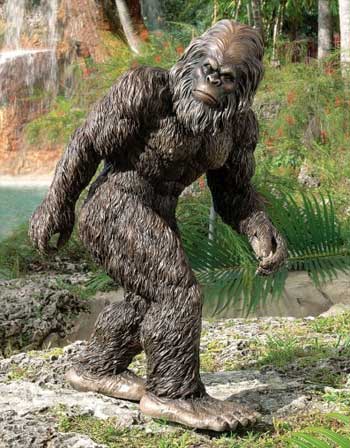
Yowie

Edward: The author of the above article, “And There Were Giants” (published in the Psychic Australian, Oct. 1976) is Rex Gilroy, a believer in pyramids lying far beneath the seas and lots of other unusual stuff to say the least. See Gilroyʼs homepage

Note that the photos in Gilroyʼs article are all of himself and his so-called “discoveries,” namely a few large rocks and some casts of what he claims are genuine “giant human footprints.” Rex vainly tries to “link” his discoveries with those of the famous anthropologist, Dr. Ralph von Koenigswald, who discovered fossilized teeth and jaw remains of the largest known species of ancient ape, Giganopithecus.

Problems

  1. Rex cites only the most exagerrated height figures for Gigantopithecus. Gigantopithecus (of the Middle Pleistocene of what is now northern Vietnam and southern China) featured males that stood an estimated 9 ft tall and weighed about 272 kg 600 lb. Please note that it is risky in the case of large primates to correlate tooth size and jaw depth of primates with their height and body weight, and Gigantopithecus may have had a disproportionately large head, jaws and teeth for his body size. So it could have been smaller than 9 ft. tall. And the only Gigantopithecus remains that have been discovered so far are three partial lower jaws and more than 1,000 teeth.

  2. Rex wants to believe that the fossilized teeth and jaw remains of Gigantopithecus point to it having been human. It was not. See, “The Ape That Was: Asian Fossils Reveal Humanityʼs Giant Cousin” by Russell L. Ciochon for a detailed discussion of why Gigantophithecus was a species of ape.

  3. Rex believes his rocks are “tools,” yet I donʼt see any chisel marks or even usage marks on those mishapen rocks that Rex picked up. (And if young-earth creationists believe in “giants before the Flood” and that Rexʼs “human giant” was one of them, they ought to also consider the old adage “sinks like a stone,” and ask themselves how Rexʼs huge “stone tools” floated on the waves during “The Flood of Noah.”)

  4. Rexʼs so-called genuine “human footprints” are flat, they have no arch, the toes looked splayed in a fake fashion. Just check out these photos of them at Rexʼs page

In short his “human footprints” lack any true anatomical features. And furthermore, he apparently found them lying on the topmost surface of the land, the prints were not dug up beneath any sediments. And he claims they were made recently, and that such creatures are alive now. He calls these creatures “Yowies.” Below is a story of someone who took a trip with Rex in the outback looking for evidence of his beloved “Yowie.”

The yowie, on the other hand, has left only meager traces of its supposed existence, like those of other hairy man-beasts reported around the world. These include the Himalayan yeti, the North American sasquatch, and similar creatures alleged to inhabit remote regions of China, Russia, southeast Asia, and elsewhere.
The yowie is a fearsome, hairy creature of Aboriginal mythology. Also called Doolagahl (“great hairy man”), it is venerated as a sacred being from the time of creation which the Aborigines call the Dreamtime. An alleged sighting by a hunting party of settlers in 1795 was followed by increased reports from the mountainous regions of New South Wales [thatʼs a region of Australia, not Britain] in the nineteenth century. For example, in 1875 a coal miner exploring in the Blue Mountains west of Sydney, Australia reportedly stalked a hairy, apelike animal for a distance before it finally eluded him. Sightings of the yowie mounted as settlers penetrated the countryʼs vast interior, and yowie hunter Rex Gilroy (1995, 197) now notes that his files “bulge with stories from every state.”

The self-described “‘father’ of yowie research,” Gilroy (1995, 202) boasts the acquisition of some 5,000 reports together with a collection of footprint casts, but he complains of “a lifetime of ridicule from both ignorant laymen and scientists alike.” When Peter Rodgers and I ventured into the Blue Mountains, we experienced something of the prevalent local skepticism at the information center at Echo Point (in the township of Katoomba). Staffers there were emphatic that the yowie was a mythical creature pursued by a few fringe enthusiasts. (To them yowies exist only as popular toys and chocolate figures marketed by Cadbury.) Nevertheless, to Gilroy “the Blue Mountains continues to be a hotbed of yowie man-beast activities-a vast region of hundreds of square miles still containing inaccessible forest regions seldom if ever visited by Europeans.” The fabled creatures are known there, he says, as the “Hairy Giants of Katoomba” and also as the “Killer Man-Apes of the Blue Mountains” (Gilroy 1995, 212).

In the Katoomba bushland, Peter and I took the celebrated “steepest incline railway in the world” (built as a coal mine transport in 1878) down into Jamison Valley. The miserable weather gave added emphasis to the term rainforest through which we “bushwalked” (hiked) west along a trail. We passed some abandoned coal mines that Peter humorously dubbed “yowie caves,” before eventually retracing our route. We saw no “Hairy Giants of Katoomba” but, to be fair, we encountered little wildlife. The ringing notes of the bellbird did herald our visit and announce that we were not alone.

Resuming our drive we next stopped at Meadlow Bath, an historic resort area overlooking the Megalong Valley-also reputed yowie country (Gilroy 1995, 217-218). From there we surveyed the countryside which was, however, largely shrouded in fog. We continued on to Hartley, then took a narrow, winding road some 44 kilometers to Jenolan Caves. Gilroy (1995, 219) states that the Aborigines believed the caves were anciently used as yowie lairs, and he cites reported sightings and discoveries of footprints in the region.

We passed through the Grand Arch, a majestic limestone-cavern entranceway into a hidden valley, and surveyed the spectacular grotto called Devilʼs Coachhouse, continuing our cryptozoological pursuit. We searched the surrounding mountainous terrain (see figure 3) for signs of the elusive yowie, again without success. Here and there the raucous laughter of the kookaburra seemed to mock our attempt. An employee told us he had worked at the site for three years without seeing either a yowie or the innʼs resident “ghost,” indicating he believed in neither.

Failing to encounter our quarry, we ended our hunt relatively unscathed-soaked, to be sure, and I with a slightly wrenched knee. But consider what might have been: headlines screaming, “Skeptics mauled by legendary beast!”-a tragic way to succeed, certainly, and with no guarantee, even if we survived, that we would be believed! Even Gilroy conceded (1995, 202) that “nothing short of actual physical proof-such as fossil or recent skeletal remains or a living specimen-will ever convince the scientific community of the existence of the ‘hairy man.’” But that is as it should be: In many instances the touted evidence for Bigfoot-type creatures-mostly alleged sightings and occasional footprints-has been shown to be the product of error or outright deception (Nickell 1995, 222-231). Cryptozoologists risk being thought naïve when they too quickly accept the evidence of “manimal” footprints. “Some of these tracks,” insists Gilroy (1995, 224), “have been found in virtually inaccessible forest regions by sheer chance and, in my view, must therefore be accepted as authentic yowie footprints.”

Science and Scripture

Although Ramm presents it as a “prediction” it is not much of one since he says there were already were at least 55 fossil hominids in his day:
“It has been incorrectly asserted that the fossil remains of man are few and fragmentary. It is argued that from a small basketful of enigmatical bones an entire evolutionary history of humanity is constructed. This might have been the case a half-century ago but it is no longer a valid objection. There are fifteen skulls or fragments of Sinanthropus Pekinensis, and of other prehistoric men there are as many as forty skeletons. For one Piltdown skull which must be given up there are one or two dozen to take its place. Dr. Broom has scurried around South Africa with great zeal, turning up numerous skulls. If a hundred Dr. Brooms were to work as diligently in all the world we might well fill a museum up with prehistoric human fossils. Evangelicals must seriously reckon with this as a real possibility and be prepared for it. The anthropologist cannot be discounted any longer on the ground that all he has to work with is a basketful of controversial bones.” (Ramm B.L., “The Christian View of Science and Scripture,” [1955], Paternoster: Exeter, Devon UK, 1967, reprint, p.216)
Science and Scripture

Gish of course was not impressed by Rammʼs list at the time Ramm made it above, and hence Gish scorned both Peking Man and Piltdown. And Australian creationist Quote Book boasted until recently that “there were barely enough remains of early man to fill a coffin.” It wasnʼt until 1994 that I read about young-earthers Agreeing With Ramm and saying things like:

“I was surprised to find that instead of enough fossils barely to fit into a coffin, as one evolutionist once stated [in 1982], there were over 4,000 hominid fossils as of 1976. Over 200 specimens have been classified as Neandertal and about one hundred as Homo erectus. More of these fossils have been found since 1976.” Michael J. Oard, in his review of the book, Bones of Contention
— A Creationist Assessment of Human Fossils, in the Creation Research Society Quarterly, Vol. 30, March 1994, p. 222

“The current figures [circa 1994] are even more impressive: over 220 Homo erectus fossil individuals discovered to date, possibly as many as 80 archaic Homo sapiens fossil individuals discovered to date, and well over 300 Neandertal fossil individuals discovered to date.”
Marvin L. Lubenow, author of Bones of Contention
— A Creationist Assessment of Human Fossils, in a letter to the editor of the Creation Research Society Quarterly, Vol. 31, Sept. 1994, p. 70

But Ramm said a lot more about it than that. He had a whole chapter on Anthropology and showed how the Bible and science could be interpreted harmoniously with the right *attitude* on the part of both scientists and Christians:
“B. Certain features which we tend to overlook.
1. Both geology and Scripture teach that man is the latest major form to appear on the earth.

I fully agree, in terms of sheer intellect man is the latest major form to appear on earth. But what about in terms other than sheer intellect? Depends on how you define “forms” and “major” I suppose. Genomically speaking, the change from the common ancestor of chimp and man —< to manʼs genome, did not involve a genomic change of “major form.” I bet there are plenty of creatures who have undergone greater changes in their genomes over the last five million years, notably creatures with quicker reproductive cycles than man, or creatures living in regions where mutations appear more often.

As for man appearing “last or latest” that remains a point of Biblical contention between old-earth creationist and theistic evolutionist Christians at ASA, because what “Scripture teaches” about the timing of manʼs creation is not without contention when you compare Gen. 1 and 2. Was man created first or last? Thereʼs at least one article and discussion of that topic, which is still debated at the ASA site.

As for the account of Genesis 1, taken by itself instead of compared with Genesis 2, yes, Gen. 1 says man was created last, and it also says that God rested after that. Exodus added that God “rested and was refreshed” after his six days of creation, which some translators say literally means, “rested and caught his breath.”

2. Anthropology and Scripture agree that man is the highest form of life. In Biblical language, man is in the likeness and image of God. Scientifically considered, man has
  1. the most generalized body of any organism
  2. the largest brain in ratio to the weight of the body and diameter of the spinal cord
  3. the most complex brain and,
  4. is the most intelligent of all life.

Yes, we have big brains and spinal cords, on the other hand as soon as any creature evolves that can write books, including both holy books and science books, it will recognize itself as the highest creature around, after all, it holds the pen. As far as evolving “last,” evolution doesnʼt say man came “last.” It just says that man arrived. Who knows what is going to evolve “last” (especially if you consider that the world might go on for billions of years, and that there might also be life on other worlds).

3. Anthropology and the Bible both assert that man has much in common with the animals. The Bible asserts that the animals were made from the earth (“let the earth bring forth”), and that man was made from the dust of the earth. The strong emphasis in modern science on the continuity of manʼs body with the animal world is but the realization of what is in the Biblical account already.…

Compare the proportion of different atoms and molecules in your average patch of earth with the proportion found in the human body, the latter of which is over 60% water. It would be nearer to scientific accuracy if the Bible said man was created from water than from earth. In fact manʼs blood contains similar (not exact) minerals to sea water. Also earth and clay contain loads of silicon, while manʼs body is carbon based. And of course, if you want to stress “continuity” as Ramm does above, why not point out the continuity in evolution rather than the continuity of both being created “from earth,” i.e., the fairly small genomic differences between man and chimp, which are as close as sibling species of near identical fruit flies? But the Biblical author knows nothing of this, to the ancients there were basic “elements” like earth, water, fire, air. So he had to choose among those to create man and beasts from. And he chose “earth.”

I happen to think man and the beasts were not separately and specially “created from the earth,” but from each other. And indeed if you went back far enough we even shared fish-like ancestors, which the Bible claims were created on totally separate days from the beasts of the field.

Mivart asks us to contemplate what we would do, as it were, if we were God and were going to create man. He says we would be guided by these considerations: (i) to live on his earth man must resemble animals in that he must eat, breathe, etc.;

Yes, we must eat, so what about the bacteria that infect the food we eat? Microgram for microgram, the poisons produced by some bacteria in our food are more potent than all other known poisons on earth. It is estimated that one tenth of an ounce of the toxin produced by bacteria causing botulism would be more than enough to kill everyone in the city of New York; and a 12-ounce glassful would be enough to kill all 5.9 billion human beings on the face of the Earth. (The same happens to be true of the toxin that causes tetanus.)

(ii) being an intelligent creature he must have a large nervous system; (iii) as such, no invertebrate nor reptile nor fish nor bird is so built as to be able to support such a huge nervous system;

Any creature with any system whatsoever is “built to support it” to one degree or another. Though the fact that the human pelvis is has narrowed with upright posture and the human infantʼs skull is larger in man than other primates does make birthing difficult for the human species:

Only a Designer would have had the infinite wisdom and compassion to create human beings as two-legged upright creatures based on the same skeletal design for four-legged creatures. This has led to innumerable problems for men and women. Aside from lower back pain, foot, ankle, and knee problems, “to effect upright posture based on the skeletal system of four-legged animals the human femaleʼs sacrum had to be pushed down somewhat, so that its lower end is now below both the hip socket and the upper level of the pelvic articulation…
This has resulted in an encroachment on the female pelvic cavity, thereby narrowing the birth canal and rendering it too small for comfortable birthing. The result is that human childbirth is generally painful and often dangerous. The process of giving birth exposes both the mother and her infant to sizable risks of accidents and infections. For a woman with a small pelvis the rigors of childbirth can be excruciating, even fatal. No other animal has this problem.” [Wilton Krogman, “The Scars of Human Evolution,” Scientific American, 1951 - as cited in Timothy Andersʼ The Evolution of Evil]

Only in recent times has the mortality of women and children during childbirth been greatly reduced due to advances in obstetrical medicine. Even today, however, a womanʼs chances of dying from complications during childbirth remain greater than dying from complications due to having an abortion during her first trimester of pregnancy. If only the Designer had employed a uniquely improved design instead of just jury-rigging the old four-legged skeletal system to make us walk erect!

Speaking of another flaw (albeit a minor one compared to the above), designed into the upright skeletal system of human beings are “two major blood vessels, going to the legs, that must cross a sharp promontory bone at the junction of two lower vertebrae in the spine. The organs in the pelvis exert great pressure on those two blood vessels. During pregnancy, this pressure may build up to such an extent that the vein is nearly pressed shut, making for very poor blood drainage of the left leg. This is the so-called ‘milk leg’ of pregnancy. Four-legged animals experience no such problem.” [Wilton Krogman, “The Scars of Human Evolution,” Scientific American, 1951 - as cited in Timothy Andersʼ The Evolution of Evil]

But overall, any living creature with any system whatsoever is supported by that system and vice versa, or the creature dies, a fact that both creationists and I.D.ers and Darwinianʼs agree upon. Now please explain creatures that are awkwardly built or that exhibit atavisms like legs on modern day whale fetuses and whales. Or like toes on pigs that donʼt touch the ground as they walk? Or like giraffe babies falling several feet and landing on their heads at birth? Iʼm sure the explanation is that “they had to be created that way, because of natural limitations within creation itself.” Well, Darwinism also agrees there are natural limitations, and that creatures evolving in certain directions are impeded to various degrees by the directions they have evolved in. So Mirvatʼs arguments seem to prove very little when you think about them. Similar arguments work for all sides. (Thatʼs why I donʼt like to categorize myself as either an I.D.er nor a Darwinian, I still have questions. I just happen to be asking them of I.D.erʼs more often these days. My own personal hopes as I have said are of a higher power and an afterlife, based perhaps on the anthropic principle and perhaps also on some arguments in Dentonʼs second book.)

(iv) whales, porpoises, and seals are ruled out as they lack large enough nervous systems, and for the same reason we must (v) rule out the hoofed animals;
(vi) this restricts us to the carnivores, and among the carnivores those who have a body most closely suited to what man should possess are the simians. The many traits that man has in common with animal life, and his marked similarities to the simians, should come then, upon mature reflection, as no great surprise.

And equally no great surprise either to creationists nor to evolutionists, which again proves nothing.

4. Geological and anthropological evidence is not the only source of our information about manʼs origin. Manʼs nature investigated through psychology and reflected upon in theology and philosophy, is also evidence as to his divine origin. It is not possible to account for manʼs great intelligence, his conscience, his spiritual experiences, his artistic creations, on purely naturalistic premises.

Who really knows how to account for everything? Naturalists canʼt account for everything and admit it, but theists account for reason by positing Divine Reason, and they account from design by positing a Divine Designer, and they account for artistic creations by positing a Divine Artist, and they account for intelligence by positing Divine Intelligence. Sounds like the theists are accounting for everything simply by using the same word and capitalizing it. Kind of like circular reasoning. So neither naturalist nor theist has a step by step account of everything. Though naturalists, especially methodologically speaking seem more inclined to inquire into questions in a step by step fashion rather than positing the same thing and capitalizing it.

There is a divine element detectable in human nature now which indicates a divine origin of man in the past. Only the Biblical account which asserts the double origin of man (from dust, from God) is true to the total man. Any present conflict between Genesis and anthropology does not obviate the fact of a present and detectable divine element in human nature, and therefore the necessity of a divine origin of the divine element in that human nature.

Edward: Every major religion, even ones without Genesis-like creation accounts, seems to agree that there is something divine in man, something that is eternal.

5. Perhaps our problem is interpretative. Maybe our trouble is that we are trying to apply modern methods of historiography to a method of divine revelation which will not yield to such a treatment… Until we get further light from science or archaeology we must suspend judgment as to any final theory of the harmonization of Genesis and anthropology …

(Ramm B.L., “The Christian View of Science and Scripture,” [1955], Paternoster: Exeter, Devon UK, 1967, reprint, pp.229-230)

I like that! Suspending judgment. Seems very reasonable to me. Ramm just cited the broadest outlines of a few basic “harmonies” between science and scripture, though I even question some of his points. He is also brave enough to mention “present conflicts between Genesis and anthropology” in point four. Yes, I too see the conflicts, and the non-special nature of the Genesis account, “historiographically” speaking.